
Pixx Restaurant App vs Voting App: Which Solves Group Dining?
Pixx Restaurant App vs Voting App: Which Solves Group Dining?
· 5 min read
The group chat starts at 11:47 a.m. Someone types "where should we eat tonight?" By noon, there are 47 messages, a Google Doc nobody opened, two people who haven't responded at all, and a third who typed "idc you pick." The group eventually agrees on a place. Then someone mentions they're vegan. Back to square one.
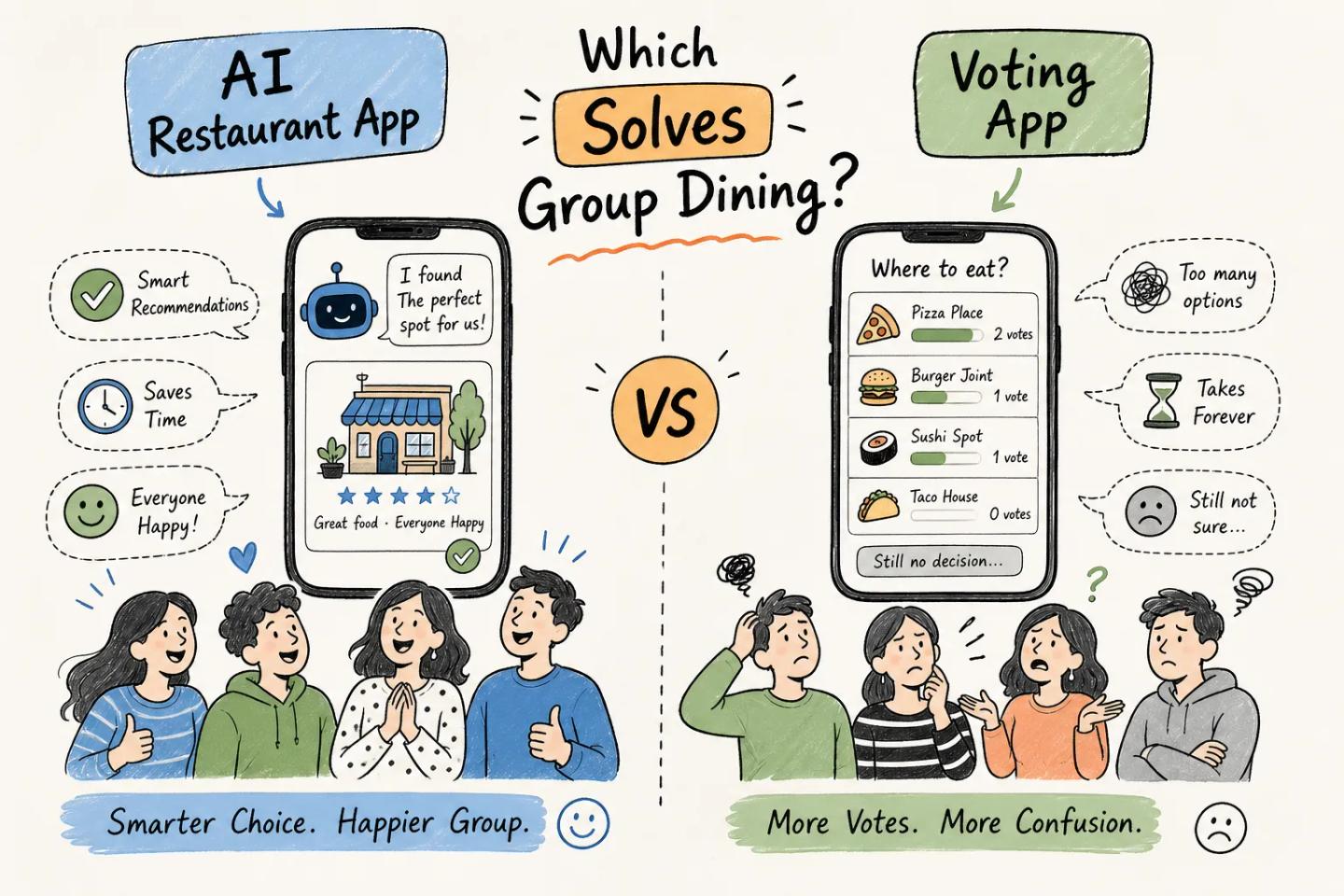
That scenario is exactly what the AI restaurant app vs voting app debate is really about. Both categories promise to fix group dining decisions. Voting apps collect opinions from everyone and surface a winner. AI restaurant apps synthesize those opinions and produce an answer. The distinction sounds subtle, but it determines whether your group actually ends up at the table or frequently falls back to the same group chat. This article breaks down exactly how each model works, where each one hits a wall, and which one your group actually needs.
Why the group dinner decision is harder than it looks
Most people treat the group dining problem as a discovery problem: "We just need to find the right restaurant." That framing misses the actual friction. The hard part isn't finding restaurants, there are thousands of them. The hard part is synthesis: taking six people with six different preferences, three dietary restrictions, and four different starting locations and arriving at a single answer that works for everyone.
More options don't help. In decision psychology, larger candidate sets are well-documented as a driver of decision fatigue, not clarity. When everyone has a vote but no one has accountability, choice paralysis deepens. Groups without a clear mechanism tend to default to whoever is most vocal, which isn't the same as whoever is most right.
A successful group dining decision requires several inputs to work simultaneously: cuisine compatibility, dietary restrictions, distance from multiple starting points, budget alignment, and restaurant availability. Most tools handle one or two of these inputs. Almost none handle all of them at once, which is why the decision keeps returning to the group chat even after someone supposedly made the call.
What voting apps actually do (and where they stop short)
Voting apps solve a real problem. They replace the 47-message thread with a structured moment where everyone registers a preference, and they do it faster than most groups manage on their own. Apps in this category typically follow the same core pattern: an organizer builds a shortlist of three to five restaurants, shares a link, and participants tap their top pick. The most-voted restaurant wins.
The UX is clean, and the best versions of these tools reduce participation friction significantly. When a poll-based restaurant selector doesn't require account creation, groups are far more likely to complete it. That's a meaningful design win. The problem isn't the voting mechanic itself, it's what the voting mechanic can and cannot see.
Candidate-set bias is the first structural flaw. The person who builds the shortlist controls the outcome. A restaurant can only win if it's on the list, and the list reflects whatever the organizer happened to know, search for, or prefer. This is a well-established limitation in group decision research: the composition of the candidate set shapes the result independently of the group's actual preferences. If the best option for the group wasn't included, the vote won't find it.
Dietary restrictions are the second flaw, and it's more serious. Voting logic sits largely outside the dietary layer. A restaurant can win the poll with four out of six votes and still leave the one person with a kosher requirement or a severe nut allergy with nothing safe to order. When one person's dietary need affects the whole group's experience, a poll without built-in dietary filtering creates a predictable gap. Many voting apps lack any mechanism to flag or exclude a venue that fails even one attendee. The vote closes. Someone raises the dietary issue, and the conversation returns to the chat.
Post-vote coordination compounds both problems. Who booked the reservation? What time works? Did anyone text the person who didn't vote? Voting apps produce a winner; they don't manage what comes after. That remaining coordination often falls back to the same group chat the app was supposed to replace.
AI restaurant app vs voting app: how each handles dietary restrictions and location
An AI restaurant app inverts the entire model. Instead of asking the group to evaluate a list of options, it asks each person to share their constraints and preferences. Then it runs those inputs through a restaurant recommendation algorithm and surfaces a result. The output isn't a leaderboard or a shortlist. It's an answer.
The logic shift is significant. Dietary restrictions move from post-vote objections to first-class inputs. The AI filters against them before a single restaurant is surfaced, not after a winner is announced. Location becomes a calculated travel-time balance across the whole group, not a single pin on a map. A well-designed restaurant recommendation app doesn't find a venue near the organizer, it finds one that minimizes total travel across everyone attending.
Consider a concrete scenario: six people, two vegans, one kosher diner, one with a gluten intolerance, coming from three different neighborhoods across the city. A basic voting app would struggle with this group unless the organizer manually collected all four dietary requirements upfront, filtered the shortlist by hand, and avoided unconsciously favoring restaurants near their own neighborhood. Many AI recommendation engines can pre-filter by constraints before presenting results, so the group never sees the venues that didn't qualify.
Speed is also worth noting. One study comparing recommendation systems to manual group decision processes found that AI-generated suggestions reduced decision time from roughly 18, 19 minutes to under 7 minutes, when the system had sufficient preference data. The caveat matters: everyone needs to submit their preferences upfront. That's the participation challenge AI apps have to solve, and how they solve it determines whether the speed advantage holds in practice.
Pixx: the AI approach built specifically for groups
Pixx is a strong example of what an AI restaurant app looks like when the group decision problem is the entire point of the product, not a feature layered on top of a discovery tool. The core workflow is built around one principle: remove every barrier between "where should we eat?" and an actual answer.
The organizer creates a meal event and shares a single invite link. Each group member submits their dietary needs and food preferences through that link without downloading the app or creating an account. That detail matters more than it might seem. A significant failure point for any group app is incomplete participation: if even one person doesn't join, the tool is making decisions with missing data. By removing the account-creation requirement, Pixx reduces that friction, which means the AI is more likely to have the full group's inputs before it makes a recommendation.
Pixx's smart location optimization calculates travel time across all group members' starting points and weights restaurant suggestions accordingly. Nobody gets an 8-minute walk while someone else sits through a 45-minute commute. The AI treats the group's geography as a constraint the same way it treats dietary needs, built into the decision, not bolted on afterward.
Once the AI surfaces its recommendation, the group can use Pixx's built-in real-time group chat and side-by-side voting on finalists if they want to weigh in before the final call is locked. iOS Live Activities keep the meal countdown visible on the lock screen so nobody loses track of the plan. The decision, the coordination, and the reminder all live in one place rather than scattered across three different apps and a group text.
Which model actually solves the problem for your group
The honest answer is that the right tool depends on your group's complexity. Not every dinner requires an AI recommendation engine, and there's no reason to overcomplicate a simple outing with two close friends who both eat everything.
A voting app is probably sufficient when:
- The group is small (two to three people) with similar taste profiles
- Nobody has dietary restrictions or allergies
- The organizer knows the area well enough to build a solid, unbiased shortlist
- The decision is low-stakes and speed matters more than precision
For groups with dietary diversity, voting models face structural limitations they can't fully overcome. A restaurant that wins a majority vote can still be the wrong answer for one or more people. Those same limitations apply when group members are spread across a city, when the same group is making this decision every month and preference fatigue is building, and when the organizer shouldn't have to carry the full cognitive load of researching, filtering, and shortlisting alone.
For those situations, an AI group dining decision tool isn't a convenience upgrade, it's a different category of solution. Rather than asking the group to evaluate a set of options, the AI removes the options that don't qualify and delivers the one that does. That's a fundamentally different product outcome, even if both approaches involve a link and a few taps.
The right question isn't which app is better
When you weigh an AI restaurant app vs voting app, the difference comes down to this: voting apps made group restaurant decisions more democratic; AI restaurant apps made them more solvable. Those are two different goals, and conflating them is why groups end up back in the chat thread after the poll closes.
The real question is whether you want everyone to weigh in, or whether you want everyone to get an answer. Pixx is built for the latter. As a group decision app, it takes every person's dietary needs, preferences, and location and synthesizes them into a single recommendation, so the conversation can move from "where should we eat?" to "see you at 7:30."
If your group has ever spent more time deciding where to eat than actually eating, Pixx is free on iOS and Android. The AI handles the rest.