
Best AI Food Picker Apps of 2026 Ranked
Finding the best AI food picker has never mattered more, and it has never been more confusing. Groups often spend many frustrating minutes in a group chat debating where to eat, and solo diners face a separate problem: decision fatigue after scrolling through endless restaurant listings without a clear answer. The best AI food picker apps promise to solve both problems, but they don't all solve the same one. Some are built for calorie tracking. Some work as an AI recipe generator for home cooking. And one app, Pixx, is built specifically to coordinate what an entire group wants to eat at the same time.
· 4 min read
Best AI Food Picker Apps of 2026 Ranked
Finding the best AI food picker has never mattered more, and it has never been more confusing. Groups often spend many frustrating minutes in a group chat debating where to eat, and solo diners face a separate problem: decision fatigue after scrolling through endless restaurant listings without a clear answer. The best AI food picker apps promise to solve both problems, but they don't all solve the same one. Some are built for calorie tracking. Some work as an AI recipe generator for home cooking. And one app, Pixx, is built specifically to coordinate what an entire group wants to eat at the same time.
This ranking cuts through the noise. Every app below was evaluated on three criteria that actually matter: how accurately the AI matches real preferences, whether it handles more than one person's needs at once, and how granular its dietary and allergy support is. Photo-based food recognition tools like MyFitnessPal were excluded because they solve a fundamentally different problem, they're an AI calorie counter app, not a food recommendation app. This list is for people who need a restaurant or meal suggestion, not a food journal.
The top picks are Pixx for groups and Eat This Much for solo macro planning, but the right answer depends entirely on your situation. Read the breakdown, match your use case to the right tool, and skip the apps that weren't built for you.
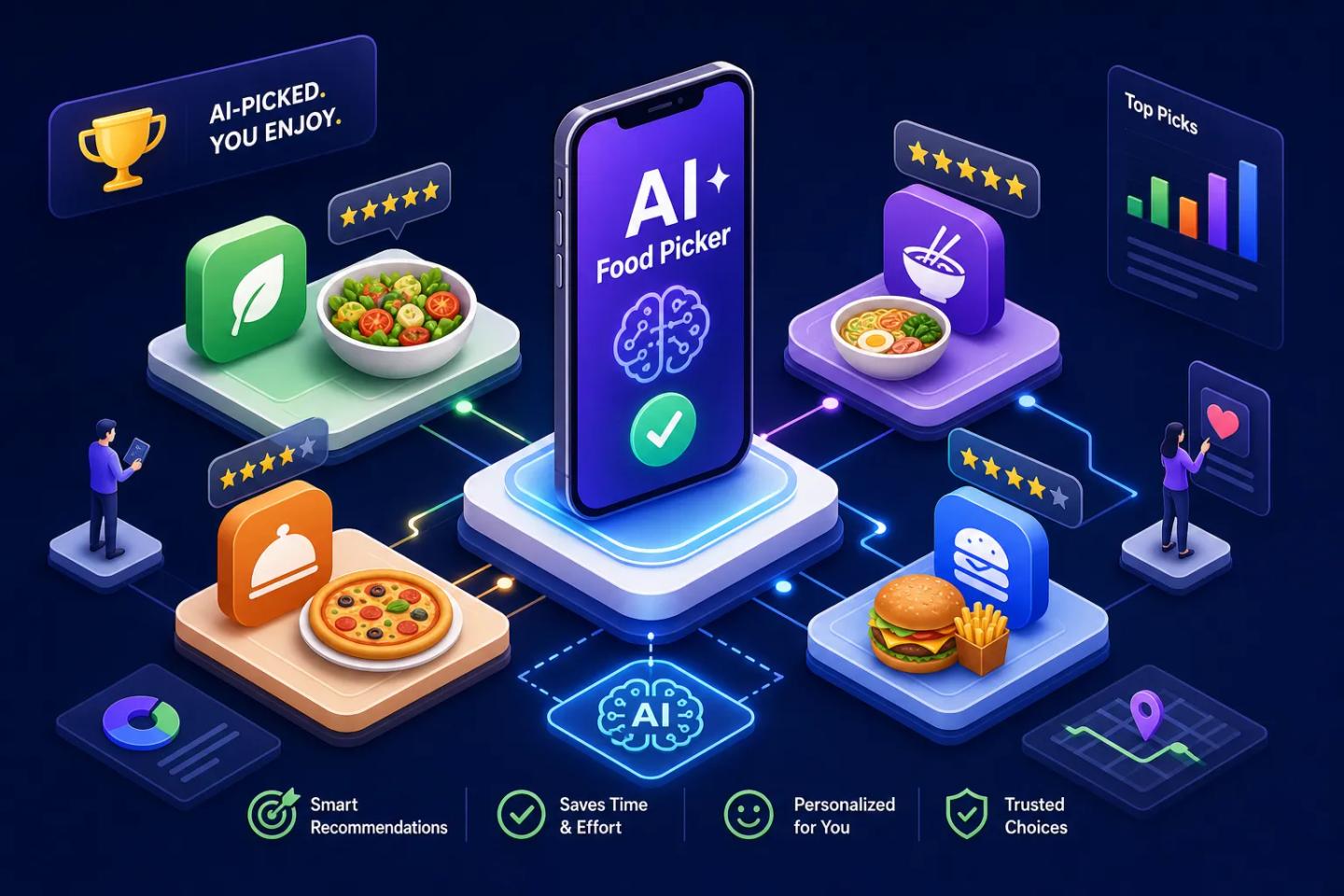
How we ranked every app on this list
Rankings without a framework are just opinions. Every app here was evaluated as a best AI food picker against three criteria that separate genuinely useful food recommendation apps from gimmicky ones: recommendation accuracy, group functionality, and dietary awareness. An app that scores well on one but fails the others still appears on this list, ranked exactly where it belongs.
The three criteria that separate useful from gimmicky
Recommendation accuracy isn't about whether an app can recognize a photo of a burrito. It's about whether the AI surfaces the right restaurant or meal on the first try, based on stated preferences, not generic popularity. A food discovery tool and an AI calorie counter app are completely different products wearing the same label, and conflating them leads to the wrong download.
Dietary awareness was judged by how granular the filtering actually gets. Does the app let you exclude specific ingredients, or just toggle a "vegetarian" switch? Can it handle a user who is both gluten-free and halal at the same time? The difference between broad presets and true restriction handling is significant for anyone with real dietary needs.
Why group functionality is the hardest problem to solve
Most food apps are built around a single user profile. When five people with three different diets try to use a solo AI meal planner together, the app fails immediately, it was never designed for that scenario. Group functionality is not just a nice feature. It is an entirely different engineering problem. An app that asks "what cuisine do you want?" cannot reconcile the needs of a vegan, a kosher guest, and someone with a shellfish allergy simultaneously. Only one app on this list was built to solve that from the ground up.
Best AI food picker apps of 2026: the full ranking
1. Pixx: best AI food picker for groups (and it's not close)
Every other app on this list requires one person to make the decision and hope the rest of the group goes along with it. Pixx works differently. It collects each group member's dietary restrictions, cuisine preferences, and location, then synthesizes all of that simultaneously to surface restaurants that actually work for everyone. No one gets left out because they're gluten-free. No one ends up at a steakhouse when half the group doesn't eat meat.
Pixx isn't a discovery app with a group feature bolted on as an afterthought. It was designed from the beginning to solve the group dining coordination problem, and no other app in this ranking comes close for multi-person use. The engineering difference shows up immediately in how the AI handles conflicting inputs.
How the AI handles conflicting preferences at once
The Pixx workflow starts with one person creating a meal event and sending a single invite link to the group. According to Pixx's app listing, guests can submit their preferences through the link without creating an account, which removes a significant friction point in group coordination. Each person enters their own dietary restrictions and food preferences, and the AI evaluates every restaurant against all profiles at once.
Here's what that looks like in practice. Imagine a group of six: one vegan, one kosher guest, one person with a shellfish allergy, and three people with no restrictions. Pixx evaluates every nearby restaurant against all six profiles simultaneously. A restaurant appears in the results only if it clears every filter, not just the majority. No one compromises on an allergy, and no one gets outvoted into an option they can't eat.
Dietary awareness and location optimization
Pixx supports vegan, vegetarian, kosher, halal, and allergy-based restrictions, covering common allergens including gluten, shellfish, and nuts. That coverage extends beyond a simple toggle, users can combine restriction types, so someone who is both halal and nut-free doesn't have to choose which filter to apply. The smart location feature goes further than most apps: instead of defaulting to the location of whoever created the event, it finds a restaurant that minimizes total travel time across all attendees. For a group spread across different neighborhoods, that distinction matters considerably.
The coordination features round out the experience in ways other apps don't attempt. Pixx includes group coordination tools designed to keep everything in one place from the first invite through the final decision, no side group chats required.
Where Pixx is the wrong tool
Pixx is a restaurant discovery and group coordination app. It does not generate home recipes, track calories, or function as a photo-based food recognition scanner. Solo users looking for a weekly AI meal planner or macro tracker will find it doesn't serve that need. For those use cases, the apps below are the right starting point.
2. Sundae: best for turning social content into a weekly meal plan
Sundae earns its spot for a specific and underserved use case: converting saved recipes from TikTok, Instagram, and YouTube into an organized weekly meal plan. Updated in August 2026, it pulls from food creators and nutritionists to build a plan with USDA-based nutrition insights and a pre-filled Instacart cart. The freemium model gives access to over 1,000 recipes at no cost, with an annual plan at $49.99 unlocking expanded features and more personalization. For someone who already follows food creators and is tired of losing recipes buried in a saved folder, Sundae removes a real friction point.
Who it works best for and how accurate it is
Sundae's AI performs well on single-ingredient and simple meals, which is where most home cooking actually happens. The USDA nutrition data is reasonably reliable for straightforward dishes, and the Instacart integration is a practical feature that other AI meal planner apps either charge a premium for or skip entirely. Dietary restriction support is functional but less granular than Mealime, so users with complex allergy profiles may find it falls short.
Group functionality: essentially zero
Sundae is a solo tool. There's no shared meal planning, no group invite, and no mechanism to reconcile two people's preferences. Households with mixed diets will run into a wall quickly. It solves the "I save too many recipes and never cook them" problem well, but coordination was never part of the design.
3. Mealime: one of the strongest dietary restriction filters in any meal planner
Mealime earns its ranking because of how deeply it handles ingredient exclusions. Users can filter by diet type and then exclude specific ingredients, covering gluten-free, dairy-free, nut-free, sesame-free, and dozens of other restrictions. For someone managing a complex allergy profile alongside a specific diet, this level of granularity is rare among free-tier apps. The free plan covers most users' needs, and the Pro tier, priced around $2.99 to $5.99 per month depending on the plan, unlocks additional meal variety.
Personalization depth and real-world accuracy
Mealime generates grocery lists, adjusts serving sizes, and delivers consistent nutrition-aware suggestions for weeknight cooking. Its filtering operates at the ingredient level, flagging items in the grocery list when a product may contain a selected allergen. This is strong mainstream filtering for the most common dietary needs, though it isn't clinical-grade, and users with severe cross-contamination concerns should supplement it with their own sourcing judgment. For the average home cook with real but manageable restrictions, it is among the most reliable options in its category.
The ceiling Mealime hits quickly
Like Sundae, Mealime is built for one user. Coordinating two households or a group with different profiles means someone has to manually compromise, which defeats the purpose of using an AI planner. It is also not a food recommendation app for dining out, so it won't help anyone find a restaurant that works for the group.
4. Eat This Much: best AI food picker for macro-driven meal planning
Eat This Much takes the most structured approach on this list. Input a calorie target and macro breakdown, and the AI builds a full day's or week's worth of meals to hit those numbers automatically. For someone following a specific plan, keto, high-protein, or a calorie deficit, this is the most direct tool available. It supports paleo, Atkins, vegetarian, vegan, and Mediterranean presets and can filter by specific allergens and ingredient dislikes. Pricing includes a free tier and a premium plan in the $5 to $9 per month range.
How the meal plan generation actually holds up
Eat This Much generates plans to match your calorie and macro goals, but real-world plans can drift from targets and may need manual adjustment or regeneration. The app acknowledges this in its own help documentation, a point of transparency worth noting. Its strength is automation, not precision. It builds a full week's plan and generates a grocery list without requiring the user to select every meal manually, which saves significant time for disciplined users who want structure without the planning overhead.
Group functionality: none
Eat This Much has no group features and cannot reconcile more than one person's targets at a time. It lives entirely in the home-cooking and meal-prep space and does not connect to restaurant discovery. For macro-driven solo users, it is the best AI meal planner on this list. For anyone coordinating a meal with other people, it's the wrong tool entirely.
Best AI food picker for groups vs. solo use: which is right for you?
The three solo apps each win a specific use case. Sundae is for the social-media recipe saver who wants a weekly plan without manually organizing every saved video. Mealime is for the home cook who needs deep allergen filtering and consistent weeknight suggestions. Eat This Much is for the structured eater who wants automation built around a specific calorie and macro target. None of them solve the group problem.
For anyone coordinating a meal for three or more people with different preferences, restrictions, or locations, the answer is Pixx. It is the only AI food recommendation app on this list designed to deliver a result for the whole group, not another list for one person to sort through alone.
Match your use case to your app
Use this as your tiebreaker. Solo macro tracker with a structured plan: Eat This Much. Solo meal planner with a complex allergy or restriction profile: Mealime. Social media recipe saver who wants a weekly grocery list: Sundae. Planning dinner for a group of any size with any mix of dietary needs: Pixx, without hesitation.
One thing every group dinner coordinator should try first
Most group meal apps require everyone to download the app and create a profile before contributing their preferences, which is where coordination efforts die. With Pixx, one person sends a link, everyone clicks it, enters their information, and the AI does the rest. According to Pixx's app listing, no account creation is required on the guest side, which addresses one of the most common friction points in getting a full group to actually participate. No group chat negotiation, no one opting out because they don't want to download another app.
Which best AI food picker app actually fits your life?
"Best AI food picker" means something different depending on whether you're eating alone or coordinating with a group. For solo users, the right app depends on whether you want an AI recipe generator pulling from social content, ingredient-level dietary filtering, or automated macro-driven planning. Each of those problems has a clear winner on this list.
For groups, only one app was built for that problem from the beginning. Pixx handles every member's preferences simultaneously, finds a location that minimizes travel for everyone, and eliminates the back-and-forth that turns group dinners into logistics projects. The invite-link approach means anyone can participate in under two minutes, and that low barrier is what makes group coordination actually work in the real world.
Try the app that matches your actual use case. If you're organizing a group meal of any size, download Pixx from the App Store or Google Play, create a free meal event, and send the link to your group. The decision gets made before anyone has time to start a group chat about it.