Best apps for planning office lunch orders in 2026
Article about the Best apps for planning office lunch orders in 2026
· 5 min read
Best apps for planning office lunch orders in 2026
If you've ever wondered what is the best app for planning office lunch orders, you already know the pain behind the question. Every office has one: the person who spends their Monday morning tracking down 23 dietary preferences, rebuilding the same group chat thread, and praying no one responds with "I'm fine with anything" right before announcing they're actually gluten-free. Research from Sharebite puts the time cost at three to five hours per week for manual lunch coordination, and that's before accounting for reimbursement tracking, wrong orders, and the colleague who didn't get the memo that the Thai place closed.
The real frustration isn't the ordering itself. It's the ten steps that happen before anyone places an order: agreeing on a restaurant, confirming it works for the vegan, the person keeping halal, and the one who's allergic to shellfish, then figuring out whose card gets charged. Most office lunch platforms treat that entire decision layer as someone else's problem. They hand you a menu and assume the hard part is already done.
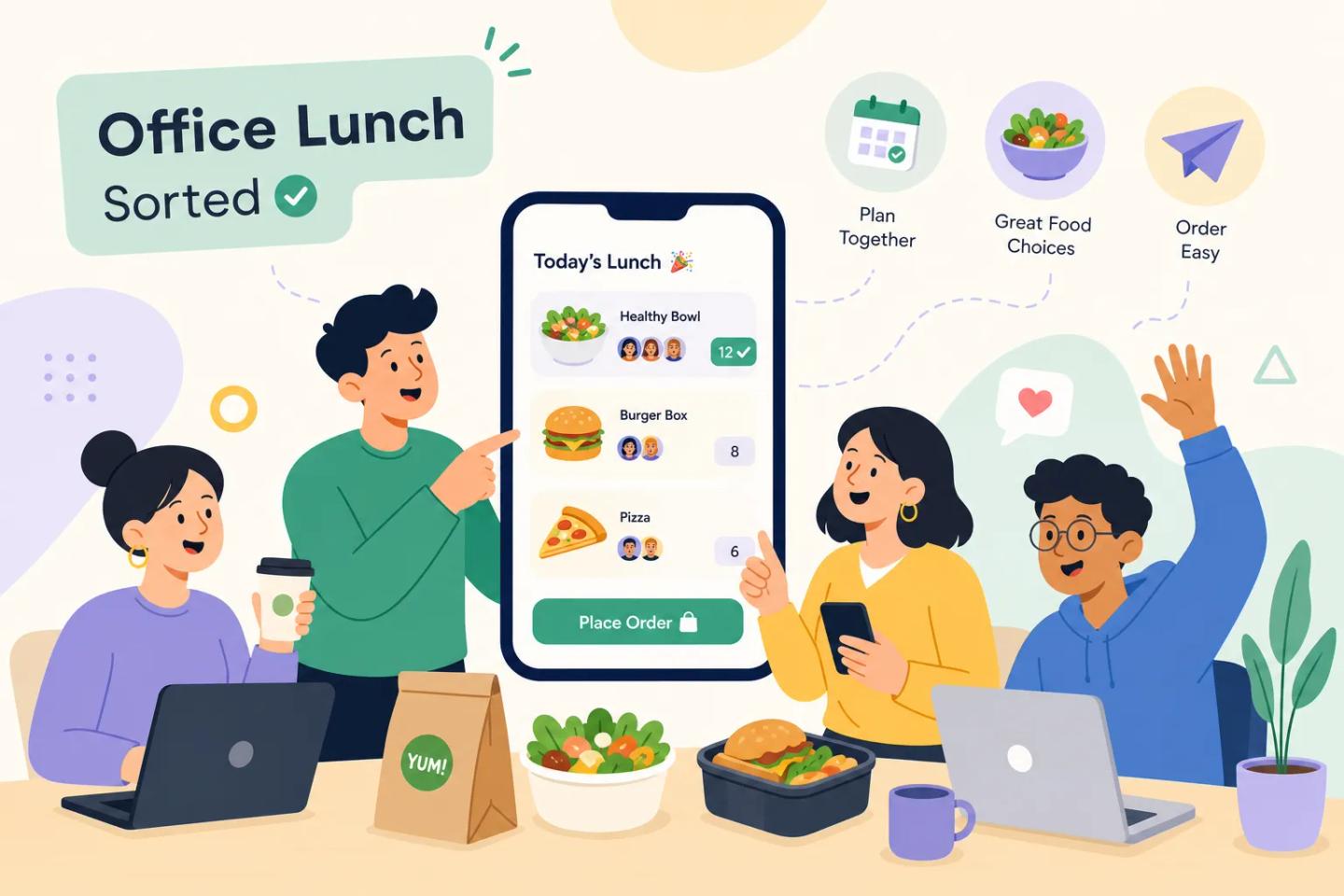
AI-powered coordination tools like Pixx have changed what's possible here. Instead of forcing the team lead to manually research whether a restaurant accommodates three different dietary restrictions, the right team lunch app now does that synthesis automatically. This article breaks down the major categories of office lunch apps, from delivery logistics platforms to group decision tools, so you finish reading knowing exactly which combination fits your team's size, budget, and workflow.
What actually makes an office lunch app worth using
Every good platform has to solve at least one of three problems: the decision problem (where does everyone actually want to eat?), the logistics problem (ordering, delivery, and billing), and the inclusion problem (ensuring no one gets a sad desk salad because the group's chosen restaurant had nothing else for them). Most apps solve one, sometimes two. Very few address all three, and that distinction matters most when you're coordinating 10 to 50 people with genuinely mixed preferences and real dietary constraints.
On pricing, the market has fragmented into several distinct models. Zero-fee delivery platforms like TryPicnic charge nothing for delivery or tips, with costs limited to the food itself. Marketplace platforms like ezCater and DoorDash for Business layer in service fees that vary by order type and caterer. Stipend-card programs like Hoppier fund individual employee cards within admin-set limits. "Free to set up" and "low total cost" are not the same thing, and the difference shows up clearly in weekly usage costs.
The recurring-versus-one-off split is also a real decision point. Recurring programs, daily or weekly scheduled orders, deliver higher long-term ROI and more consistent employee satisfaction than one-time catering events. Fooda's research frames it directly: occasional event catering has limited effects on morale over time, while recurring programs compound their impact by building team culture incrementally. If the goal is retention and team cohesion, not just feeding people at the quarterly all-hands, that trade-off belongs in the platform conversation.
What is the best app for planning office lunch orders when your team can't agree on where to eat
Most office lunch apps make a silent assumption: someone already knows what restaurant to order from. That assumption is wrong roughly 80% of the time for any team larger than five people. The "where should we even go?" conversation is where the time goes, where the friction lives, and where dietary restrictions become someone's problem to solve manually. No delivery dashboard fixes that.
Pixx is built specifically for this problem. It's an AI-powered mobile app that collects everyone's dietary restrictions, cuisine preferences, and location, then surfaces restaurant recommendations that genuinely work for the whole group, not just the majority. The workflow for an office team is straightforward: the lunch coordinator creates a meal event, sends a no-account-required invite link to the team, everyone RSVPs and shares their preferences (about 30 seconds of effort), and Pixx's AI returns a ranked set of restaurant suggestions with real-time group voting so the team can lock in a pick together.
For office teams specifically, three Pixx features stand out:
- Comprehensive dietary restriction handling, vegan, halal, kosher, gluten-free, and common allergy accommodations are all processed simultaneously at the group level, not filtered individually after the restaurant is already chosen.
- Smart location optimization, minimizes total travel time across the whole group rather than optimizing only for whoever's closest to the office.
- Built-in group chat tied to each meal event, the coordination conversation stays organized in one place instead of fragmenting across three different threads.
Pixx answers the coordination question that comes before any delivery or catering platform enters the picture. It's complementary to the platforms covered below, not a replacement for them. Use Pixx to decide where your team is going; use the right delivery app to get the food there.
Top platforms for in-office delivery and catering
TryPicnic
TryPicnic is a strong option for offices with consistent daily ordering needs and a focus on cost control. Its model is built around zero delivery fees, no tipping, and 50-plus restaurant options consolidated into a single delivery to the office. Budget controls and per-person spend limits give the admin meaningful oversight without micromanaging every order. The limitation is worth naming clearly: TryPicnic is a logistics tool, not a decision tool. It doesn't help the team agree on where to order, it assumes that decision has already been made.
ezCater and DoorDash for Business
For mid-size to enterprise offices that need scheduled catering at scale, ezCater's marketplace approach covers a large caterer network with centralized billing, recurring meal planning, and admin controls. It integrates with SAP Concur for expense management and connects to procurement platforms like Coupa and Ariba through TradeCentric, details that matter for finance teams that need clean reporting. DoorDash for Business covers flexible ordering across more than 7,000 U.S. cities, with group food ordering tools, spend controls, and scheduled delivery. It's a solid fit for teams that want flexibility without committing to a dedicated meal program structure.
Hoppier
Hoppier operates differently from all of these. Rather than coordinating a single group delivery, it funds individual employee stipend cards within admin-set parameters. That model works best for distributed or hybrid teams where a single delivery address isn't practical. Employees use their funded card for their own meals, and admins see spending in one dashboard. It solves the logistics and billing problem for remote-first teams; it doesn't touch the group decision layer at all.
How the best apps handle dietary restrictions across your whole team
A well-built dietary restriction system does three things: it captures individual preferences before the order happens (not during checkout), filters available restaurant or menu options accordingly, and flags conflicts before the group finalizes anything. That sequence matters because catching a restriction problem at the point of ordering means someone already went through the full effort of coordinating, only to backtrack.
Pixx sets the benchmark here. Its AI processes the entire group's restrictions simultaneously and only recommends restaurants with menu options that accommodate everyone, not restaurants where most people can find something. For an office with a vegan, two people keeping halal, and one colleague with a tree nut allergy, Pixx surfaces restaurants where all four can actually order, rather than surfacing the statistically most accommodating option and hoping for the best.
Most delivery and catering platforms handle dietary filtering at the individual level and as an opt-in. An office manager using ezCater or DoorDash for Business has to manually verify that the chosen restaurant or caterer has compliant options for each restriction on the team. The platform doesn't flag the gap proactively. In a group of 30 people, you can expect four or five distinct dietary needs at the same table, and according to industry surveys, roughly 40% of U.S. households include someone with a dietary restriction, which means the odds of at least one conflict in any office order are high. When restrictions get missed, someone orders separately, skips the meal entirely, or eats something they shouldn't. That's exactly the friction a recurring meal program is supposed to eliminate.
What the ROI data shows for recurring lunch programs
That same Sharebite figure, three to five hours per week, translates into a meaningful operational cost when you run it across an entire quarter at a mid-level salary. Automated recurring ordering through a corporate lunch ordering platform, combined with centralized billing and built-in reporting, recovers that time directly. The ROI case for a dedicated platform almost always closes faster than decision-makers expect.
The employee satisfaction data makes the retention argument equally clear. DoorDash for Business cites a 91% satisfaction rate among employees in meal benefit programs, compared to 78% for those without them. That gap isn't just about food quality. It's about the signal a recurring program sends: consistent investment in daily experience, not a one-time gesture at the holiday party. Employees experience weekly meal programs differently than they experience occasional catering events, and that difference shows up in morale surveys. The platform choice is also a culture choice.
How to choose the best app for planning office lunch orders
The decision framework doesn't need to be complicated. Small teams under 20 people who regularly dine out together get the most value from Pixx for coordination, paired with a flexible delivery app for days the group stays in. Mid-size offices with 20 to 100 people and consistent in-office schedules are the core market for an office meal delivery service like TryPicnic or DoorDash for Business. Large or geographically distributed teams should evaluate ezCater for scheduled catering and Hoppier for individual stipend programs that scale across locations.
Before trialing any group food ordering platform, three questions cut through the marketing:
- Does this platform handle dietary restrictions at the group level, or does it expect each individual to filter for themselves at checkout?
- Does the pricing model match your actual cadence, or are you paying per-order fees for a daily program that should be subscription-based?
- Does this solve the group coordination problem, or does it add another tool to a stack that already isn't working?
Trial one or two platforms simultaneously for a real team lunch before committing. Measure two things: how much admin time the coordinator spent compared to the previous approach, and whether anyone on the team felt left out of the meal. Those two data points are cleaner success signals than any feature checklist.
The takeaway for office lunch coordinators
So what is the best app for planning office lunch orders? The honest answer is that it depends on which problem you're actually trying to solve. Most corporate lunch ordering software on the market solves logistics. Very few solve the decision layer that precedes every order, and skipping that step is usually where the group chat spiral starts.
Before you pick a delivery platform, make sure your team actually agrees on where they want to eat. Pixx is built specifically for that problem: it collects everyone's preferences, handles dietary restrictions at the group level, and returns a restaurant recommendation the whole team can get behind. No group chat spiral required. Pixx is free on iOS and Android, run it on your next team lunch before layering in whichever delivery or catering platform fits your office's operational workflow. The coordination problem and the logistics problem both have answers now. Use the right tool for each.