
Best Group Dining App vs Yelp: Which One Wins?
The real question isn't whether Yelp is a good app. It is. The question is whether it's the right app when your group includes a vegan, someone with a tree nut allergy, and six different zip codes to account for. This article walks through what Yelp actually does well, runs that exact scenario through both Yelp and Pixx, and gives you a clear answer on which one wins for group dining.
· 5 min read
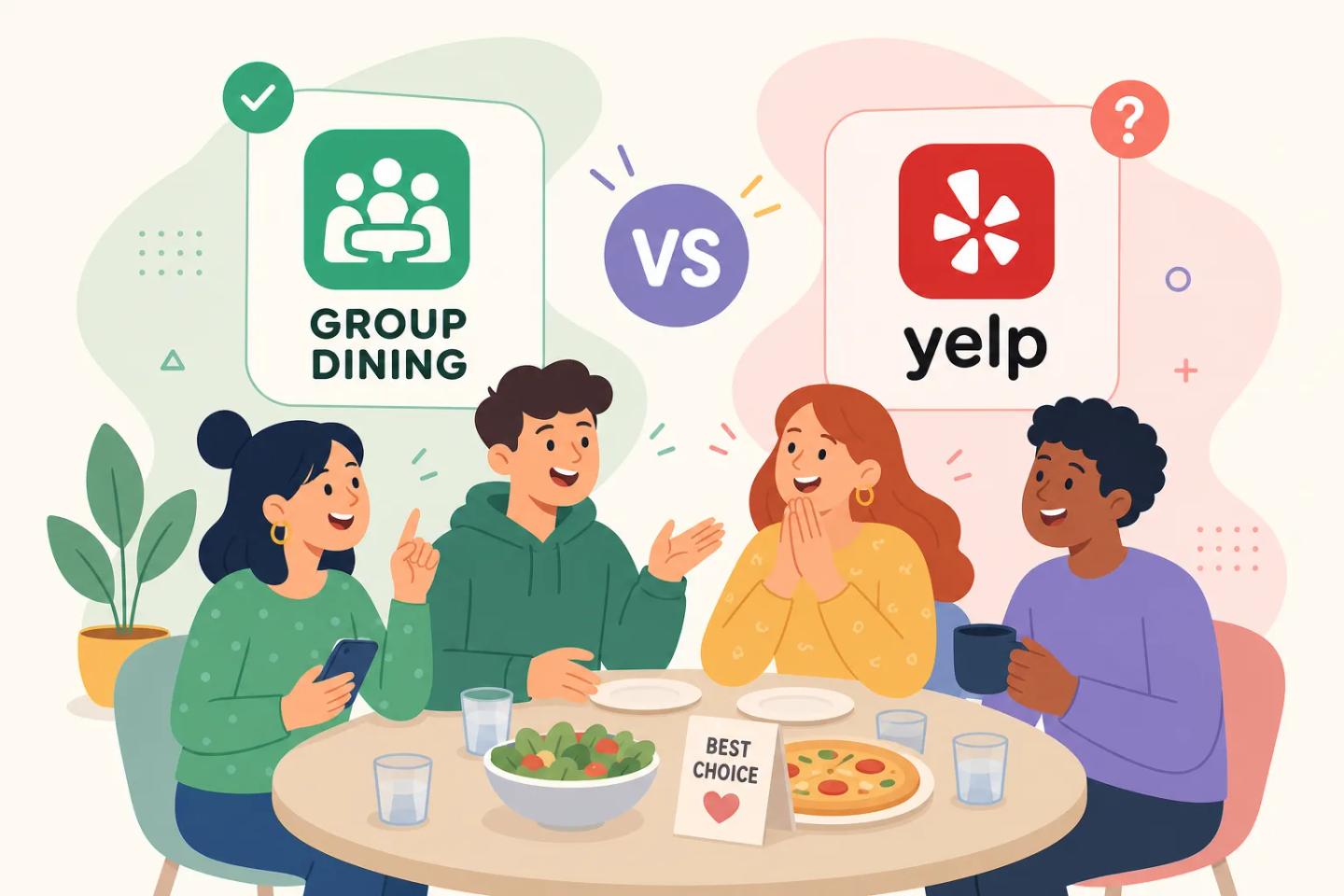
It's Thursday afternoon. Someone drops a message in the group chat: "Friday dinner?" Within four minutes, there are six opinions, two people have mentioned dietary needs, and the thread has already devolved into a string of shrug emojis. Someone finally volunteers to find a place. They open Yelp, start filtering, and twenty minutes later the group is no closer to a decision than when the chat started. Sound familiar? You're not doing it wrong, the tool was just built for a different problem than the one you're trying to solve.
The real question isn't whether Yelp is a good app. It is. The question is whether it's the right app when your group includes a vegan, someone with a tree nut allergy, and six different zip codes to account for. This article walks through what Yelp actually does well, runs that exact scenario through both Yelp and Pixx, and gives you a clear answer on which one wins for group dining. No hedging.
What Yelp actually gives you for group dining
Yelp's strengths as a discovery tool
Yelp has built one of the most comprehensive restaurant databases available to consumers. Its search filters cover cuisine type, price range, neighborhood, and broad dietary categories. Photos, review volume, and Yelp Reservations for direct booking at participating restaurants round out a product that's well-suited for a specific use case: one person researching restaurants they already have in mind, or exploring a neighborhood solo. For that job, Yelp is hard to beat.
Yelp also lets individual users save dietary preferences like vegan, gluten-free, halal, kosher, and vegetarian. The app uses those saved preferences to surface and rank matching results. That's a real feature, and it works reasonably well when one person is browsing for themselves.
Where the tool hands the work back to you
Here's the structural problem: Yelp's filters work for one person in one search session. There is no mechanism that takes six people's restrictions and cross-references them against a single restaurant simultaneously. If you filter for "vegan-friendly Thai near downtown," you get a list. What you don't get is any indication of which restaurants on that list also handle nut allergens transparently, or which one sits at the midpoint between friends coming from three different neighborhoods.
Yelp is a discovery engine. It was designed to help you find restaurants, not to help a group decide together. The person who volunteers to search bears all the cognitive load: reading menus, Googling allergen policies, estimating travel times, and then re-presenting options in the group chat to be debated all over again. The app does none of that synthesis. It hands you a longer list and steps back.
The real scenario: six friends, one vegan, one nut allergy
How this plays out in the group chat
Six people, Friday dinner, one is vegan, one has a documented tree nut allergy. The volunteer opens Yelp and filters for vegan-friendly restaurants. Sixty-plus results appear. Now comes the real work: which of those restaurants also clearly discloses nut-allergen information, or at minimum has transparent enough menu detail to make a judgment call? Yelp's restaurant profiles surface what the business has chosen to share. Most listings don't include structured allergen data. Broad "vegan-friendly" tags don't tell you whether the kitchen uses cashew cream as a dairy substitute, which would be exactly the wrong call for someone with a tree nut allergy.
So the volunteer starts opening individual restaurant websites, looking for full menus, and in some cases Googling the restaurant name plus "nut allergy" to find review comments. Meanwhile the group chat is quiet for fifteen minutes, then suddenly noisy again with suggestions that came from someone else's quick Googling, none of which have been vetted for both restrictions. Anyone who's been the volunteer in this situation knows it rarely wraps up in under twenty minutes. With competing dietary needs and no coordination tool, that timeline stretches further still.
Why this is the default experience, not the exception
This isn't a rare edge case affecting a small slice of groups. The majority of friend groups dining out together will hit some version of this scenario regularly, factor in lifestyle dietary choices like veganism alongside documented allergies, and the overlap problem becomes the rule rather than the exception. Yelp was designed for a world where one person decides. The reality of group dining in 2026 doesn't look like that.
How Pixx handles what Yelp can't
Setting up the meal event takes two minutes
Pixx starts from a completely different premise. One person creates a meal event in the app and sends a single invite link to the group. The vegan friend taps the link and marks her preference. The friend with the tree nut allergy logs his restriction. Nobody needs to download the app. Nobody creates an account. The friction that normally kills group participation before it starts is removed entirely.
While everyone RSVPs and fills in their details, Pixx collects the group's complete dietary picture in the background. There's no group chat thread asking "wait, are you still vegan?" or "does your nut thing include pine nuts?" That information lives in the app, tied to the meal event, and ready for the AI doing the actual work. A complete group profile gives the AI more to work with, and the recommendations reflect it.
What the AI does with that information
Pixx doesn't filter for "vegan-friendly" and hand you a list. Its AI cross-references vegan menu availability and nut-allergen safety at the same restaurants simultaneously, surfacing only the options that clear both bars. It also factors in where each group member is traveling from, using smart location optimization to minimize total travel time across the group. Not your travel time. Everyone's.
The result isn't sixty options. It's three or four restaurants that actually work for the whole group, ranked by how well they fit. For groups where dietary restrictions make most recommendation systems unreliable, this matters more than it might seem. AI systems that treat vegan and nut-free as independent filters can miss the overlap problem entirely. Pixx is built specifically to surface only restaurants where both conditions are satisfied at the same time.
The match score: why it removes the debate
Each Pixx recommendation comes with a transparent match score and a plain-language explanation of why it works for the group. The vegan can see that the restaurant covers her needs. The person with the nut allergy can see why the option is flagged as appropriate. Everyone can vote on the shortlist through a side-by-side view where the whole group's preferences are visible at once. The decision that typically takes thirty minutes of back-and-forth in a chat thread takes about ninety seconds with Pixx's voting layer. That's not a small improvement. That's a different product category entirely.
Group coordination: what happens after the pick
Yelp's involvement ends at the restaurant page
Once Yelp surfaces a restaurant and a reservation is made, it's done. Everything that comes after, confirming who's actually coming, sharing the address, sending a reminder the morning of, handling the person who texts "wait, where are we going again?" at 6:45 pm, migrates back to the group chat. Discovery and coordination are completely separate. You used Yelp to find the place, and now you're relying on a combination of iMessage, Instagram DMs, and one person's memory to make sure everyone shows up.
Pixx keeps the group connected through dinner
Pixx keeps the entire meal event in one place. Built-in group chat is tied directly to the event, so coordination conversations don't get buried in other threads. RSVPs are tracked in the app, so the organizer can see at a glance who's confirmed. iOS Live Activities push the meal countdown and real-time updates directly to the lock screen, which means no one has to open anything to stay informed. The address, time, and restaurant choice live in the same event view as the conversation about splitting the Uber. There's no re-sending information that already exists somewhere in the app.
When Yelp still makes sense (and when it doesn't)
Yelp is hard to beat for solo browsing and review research
This comparison shouldn't overstate the case. If one person wants to research a neighborhood, read recent reviews before booking a specific spot, or check photos to confirm the vibe matches the occasion, Yelp is a strong choice for that job. Its review volume and search depth are assets that take years to build. For individual discovery, whether you're scoping out a new area or vetting a restaurant you heard about from a friend, Yelp belongs in your toolkit.
Group dining with any dietary complexity is a different problem
The line is clear once you draw it. The moment a group has two or more people with distinct dietary needs, Yelp's list-and-filter model stops scaling. The person searching bears all the cognitive load while everyone else waits. For groups where everyone needs to agree, dietary restrictions are real and specific, and members are spread across a city, a purpose-built coordination tool like Pixx isn't just an upgrade. It's the difference between a decision in two minutes and a forty-five-minute group chat spiral that ends with someone picking a place because everyone is hungry and frustrated.
The verdict: which one wins for your group
For solo discovery and restaurant research, Yelp is a solid tool with a legitimate place in how people find food. That's an honest answer. But when the question is "where should our whole group eat", and that group includes a vegan, someone with a nut allergy, or any real combination of dietary constraints, Yelp leaves the hardest work undone. It gives you a longer list. It doesn't give you an answer.
Pixx was built specifically for the group decision problem. The AI synthesizes everyone's preferences, restrictions, and locations into a recommendation that actually works. The coordination layer, including voting, chat, location optimization, and live updates, closes the gap between "we picked a place" and "everyone actually shows up." Those are two different outcomes, and only one of them ends with dinner.
If your group has ever spent half an hour in a chat deciding where to eat, you already know which app wins. Pixx is free on iOS and Android, and your friends don't need an account to join the meal event.