
Is an AI Restaurant Picker Better Than a Voting App?
Is an AI Restaurant Picker Better Than a Voting App?
· 4 min read
Is an AI restaurant picker better than a group voting app? You already know how the alternative plays out. Someone drops "where should we eat tonight?" into the group chat at 6:30 PM, and by 7:10 PM there are eleven messages, three emoji reactions, one person who suggested a steakhouse, one vegan who went quiet, someone who mentioned gluten, and absolutely no decision. The person who started the thread is now staring at their phone, silently regretting everything.
Two categories of apps exist to fix this. Group voting apps let everyone weigh in on a list of options. AI-powered restaurant pickers analyze what the group actually needs before surfacing any option at all. Pixx sits firmly in that second category, and the difference between the two approaches is more significant than it first appears.
The core distinction isn't speed or interface design. It's about where the hard work happens. Voting apps move the decision to the group but leave the curation step to one person working with incomplete information. AI pickers handle that curation step automatically. Here's exactly what that means when your group is trying to eat before 8 PM.
How group voting apps actually work
The list-building step that nobody plans for
Before anyone in your group casts a single vote, someone has to build the list they're voting on. Apps like LunchOS Pro, ForkYes, and Fork in the Road all follow the same basic pattern: a host sets a location, applies filters, and generates a pool of restaurants. The app handles the voting mechanics well. The list-building is still largely a human job, shaped by whatever the host happened to think of and whichever filters they remembered to apply.
That gap matters more than it looks. If the host doesn't filter for vegan-friendly restaurants, the vegan in your group spends the next five minutes swiping through a list that was never going to work for them. The app didn't fail; the premise did. The voting app assumes the right list exists before the voting starts. That assumption is where most group dining problems actually live.
What a vote actually produces
The end result of a group vote is the restaurant with the most swipes or clicks. That sounds like a fair outcome, and in one sense it is: everyone had an equal say. But fairness applied to a flawed shortlist is still a flawed outcome. The most popular pick from an incomplete list is just the least-bad option the host happened to include.
For groups with dietary restrictions, allergies, or people coming from different parts of the city, this surfaces at the worst possible moment: at the table, when someone realizes the winning restaurant doesn't have anything they can actually eat. Voting apps surface group opinions. They don't verify that the options on the table actually work for the whole table.
Is an AI Restaurant Picker Better Than a Group Voting App? A Look at How They Differ
Preference aggregation happens before the first option appears
The fundamental shift with an AI-based approach is the order of operations. Instead of a host assembling a shortlist and then collecting votes, the system collects inputs from every group member first, then generates options that already clear everyone's baseline requirements. There's no manual list to curate because the AI builds the list dynamically, using each person's dietary needs, cuisine preferences, location, and past favorites as actual inputs rather than afterthoughts.
Problems get resolved before anyone sees a single restaurant name, not discovered after the vote closes. That's not a minor workflow difference. That's a fundamentally different solution to a more complete version of the problem.
Dietary restrictions as hard constraints, not afterthoughts
Picture a group of six people: one halal eater, one vegan, one person with gluten intolerance, and three people with no restrictions. A voting app gives all six an equal vote on whatever list the host created. An AI-powered dining recommendation tool maps cross-group compatibility first, so only restaurants that genuinely work for all six people ever enter the picture.
According to population-level estimates, roughly six in ten Americans report some form of dietary restriction or food allergy, a figure that makes dietary conflicts in group dining a common occurrence rather than an edge case. If you've organized more than a handful of group dinners, you already know this firsthand. For groups with at least one dietary constraint, the host-curation model has a structural flaw: the person who sets up the session has to know every constraint and remember to filter for all of them simultaneously. An AI-driven recommendation system treats those constraints as hard filters, not suggestions.
How these two approaches compare on the criteria that matter most
Speed and cognitive load
Voting apps add sequential steps: list creation, session setup, invite distribution, voting round, tiebreak if needed. AI-based group dining tools collapse those steps into a single flow where inputs go in and a recommendation comes out. Anyone who has organized a group dinner knows how quickly that deliberation clock runs. Groups routinely spend 10 to 15 minutes just deciding where to eat, with some stretching that into 30 or 40 minutes. Removing the curation and tiebreak steps doesn't rush the group, it eliminates the steps that create delay in the first place.
The efficiency gain is structural, not cosmetic. Fewer handoffs means fewer places for the process to stall, and a recommendation that already clears everyone's requirements means the group isn't circling back to veto a popular pick after the vote is done.
Fairness and who actually gets protected
Voting apps produce democratic outcomes, but democratic outcomes on an incomplete dataset aren't actually fair: they're just popular. The majority wins, but the majority didn't know about every constraint in the room. One person with a severe shellfish allergy doesn't get protected because the group voted for a seafood restaurant. The vote was fair. The outcome wasn't.
Well-designed AI-based recommendation systems treat each member's dietary restrictions and preferences as hard filters rather than inputs to be outvoted. The person with the strictest constraint gets the same protection as the person with no constraints at all. That's a different and more complete definition of fairness: not "everyone had a vote" but "no one's needs got overridden by the majority." It's worth noting that not every AI recommender implements this equally, but the category is built around that goal in a way that voting apps structurally are not.
Pixx: what AI-powered group dining actually looks like in practice
From one invite link to a unified recommendation
The Pixx workflow starts with one action: a user creates a meal event and shares a single link. Friends click that link, enter their dietary preferences and current location, and that's the extent of their required participation. The barrier to getting everyone's actual inputs into the system is designed to be as low as possible, no lengthy onboarding, no coordination overhead.
Pixx's AI ingests all of those inputs simultaneously. It finds restaurants that satisfy the group's collective dietary requirements and optimizes for a location that minimizes total travel time across the whole group. It also factors in cuisine preferences and match scores, then delivers a recommendation, not a ballot to argue over, not a shortlist to whittle down, but a specific answer built around what everyone in the group actually needs.
The real difference: a synthesized pick vs. a poll result
A voting app tells you which option the group preferred from the list someone assembled. Pixx tells you where your group should eat based on what everyone actually needs, treating dietary restrictions as hard constraints rather than opinions to be outvoted. The built-in group chat and real-time coordination features handle the remaining details once a recommendation lands, but the recommendation itself already reflects the full picture.
There's no separate curation step, no veto wars, and no moment where the person with celiac disease realizes the winning restaurant doesn't have a single safe option on the menu. The result is built around everyone at the table from the first input, not corrected for dietary constraints after the vote is already done.
When a voting app still makes sense (and when it doesn't)
The one scenario where voting holds up
A group of two or three people with no dietary restrictions, all located within a few blocks of each other, who genuinely enjoy browsing options together: for them, a voting app works fine. The list-building problem is small when the group is small and the constraints are few. Most of the friction that makes voting apps fall short simply doesn't exist for that group.
That scenario is worth acknowledging honestly rather than overselling AI for every context. If you're grabbing lunch with two coworkers who eat everything and you're all already in the same building, you don't need a sophisticated recommendation engine. You need to pick a place and go.
Why AI wins for most real-world groups
Most groups planning dinner include at least one dietary constraint, at least one person coming from a different part of the city, and at least one person who'd rather get a clear answer than swipe through five options they didn't choose. For those groups, a voting app asks them to participate in a process that was always going to fall short, because it delegates the hardest part of the problem to whichever human set up the session.
An AI-powered group dining tool like Pixx exists specifically for those situations. It was built around the group decision problem, not just the restaurant discovery problem. There's a meaningful distinction between an app that helps one person find a restaurant and an app that synthesizes an entire group's preferences, restrictions, and locations into a single answer. Most groups need the second thing.
The bottom line on voting vs. algorithmic restaurant selection
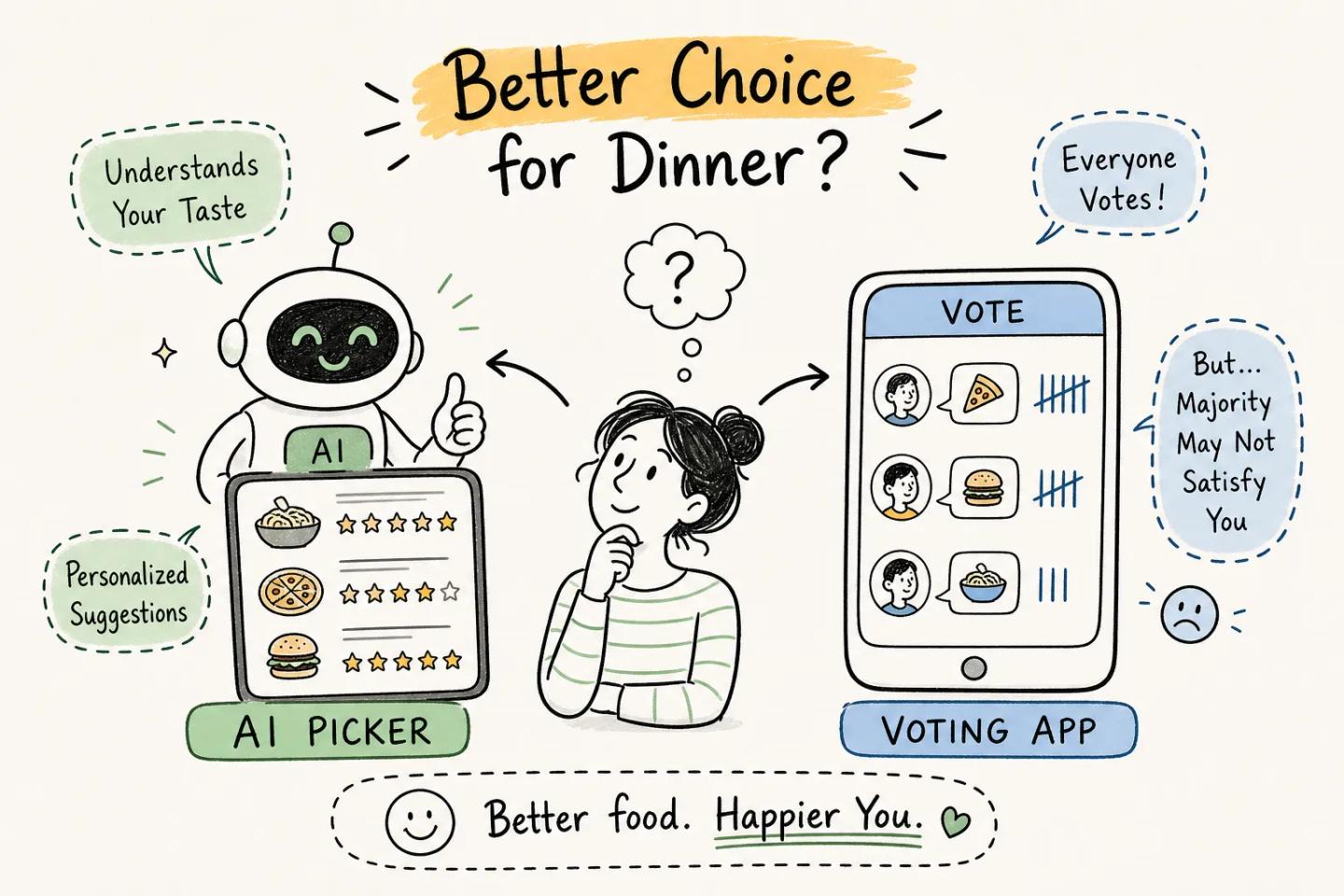
Group voting apps democratize the choice but delegate the curation to whoever sets up the session. That's a better system than a group chat spiraling for 40 minutes, but it's not the same as solving the problem. The curation step still happens, quietly, by one person, with partial information.
AI restaurant pickers address the curation step by treating everyone's preferences, restrictions, and locations as simultaneous inputs rather than sequential filters. The recommendation reflects the whole group from the start, which means the group doesn't discover mismatches after the vote closes.
If you're still asking whether an AI restaurant picker is better than a group voting app, here's the practical answer: for most real-world groups, the AI approach isn't just faster, it's solving a more complete version of the same problem. Pixx is available on iOS and Android. If your group dinners still end in a 40-minute thread with no answer, that's a straightforward problem to fix.