
Restaurant Picker App Comparison: Top Picks for 2026
Restaurant Picker App Comparison: Top Picks for 2026
· 5 min read
Every group dinner starts the same way. Someone drops "where should we eat?" into the group chat. Ten people respond with ten different ideas. Someone mentions dietary restrictions. Someone else is on the other side of the city. Forty messages later, you're still eating at the same pizza place you went to last month because nobody could agree. This restaurant picker app comparison cuts through that chaos, whether you're a solo diner, a couple, or wrangling eight people across different zip codes, so you can find the right app and get a decision made in under five minutes. Informal surveys suggest roughly 29% of Americans spend 20 minutes or more just deciding where to eat when coordinating a group, and that number climbs fast when dietary restrictions enter the picture.
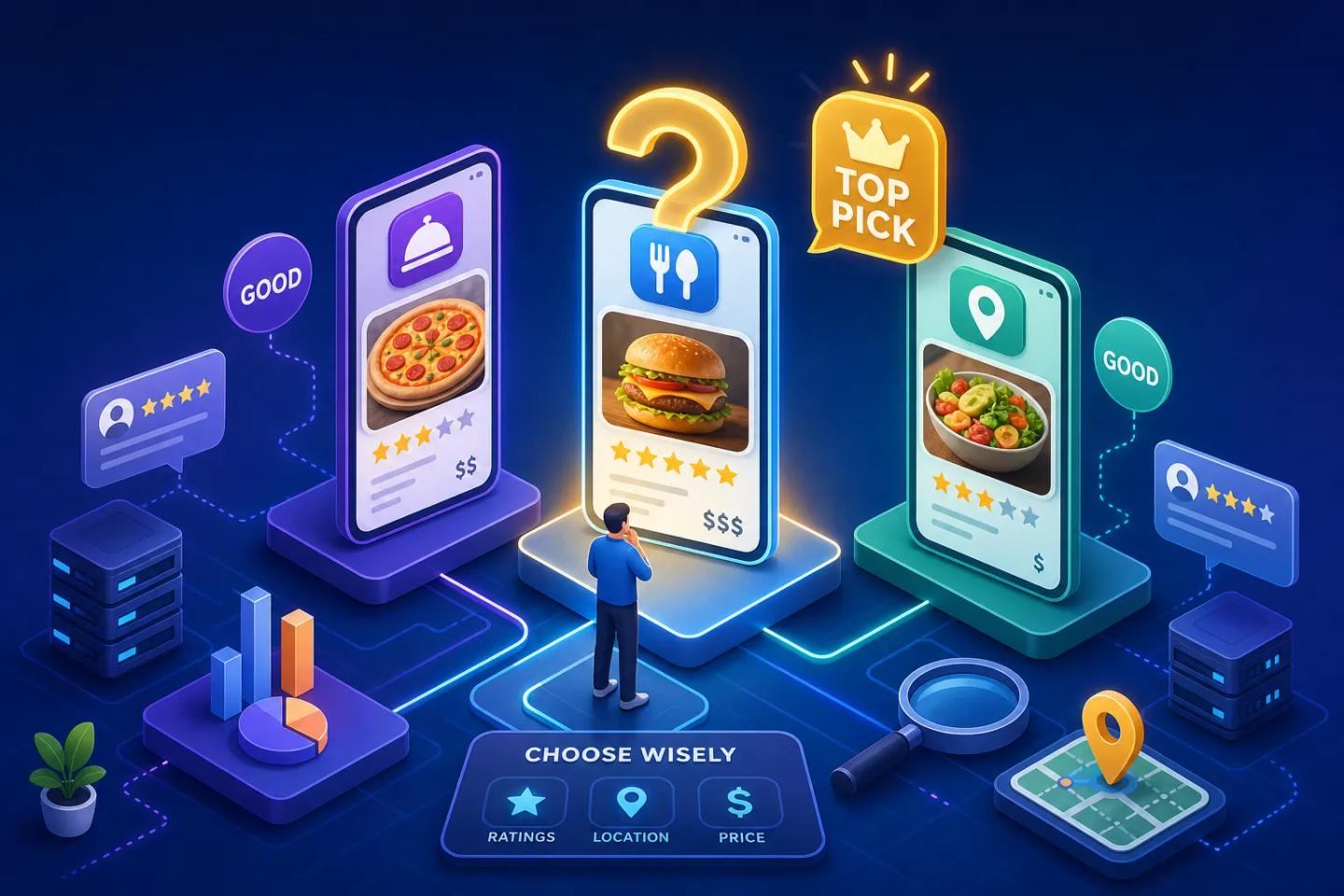
The restaurant decision app landscape in 2026 has split into two clear camps: individual discovery tools built to help one person browse options, and group decision engines built to replace the chaos entirely. The gap between those two camps is wider than most people realize. Google Maps helps you find restaurants. A genuine group dining app helps your whole group agree on one. That's a fundamentally different problem, and most apps were only designed to solve the first version. One app, Pixx, built its entire product around solving the second. By the end of this article, you'll know exactly which food picker app fits your situation and how to get it running in under five minutes.
What actually makes a restaurant picker app worth your time
App store rankings tell you which apps have the most downloads, not which apps solve your actual problem. The most-downloaded restaurant chooser apps are dominated by solo-discovery tools that happened to reach scale first. To cut through that noise, this restaurant picker app comparison evaluates every app across four dimensions: group coordination capability, AI or smart recommendation quality, dietary restriction handling, and ease of use for every person in the group, not just the organizer holding the phone.
Those four dimensions matter more than star ratings because they map directly to the moments where restaurant apps fail in real life. An app can earn 4.7 stars from millions of solo users and still be completely useless when five people with different diets and different zip codes need a single answer in under three minutes.
Why group functionality is the hardest problem to solve
A restaurant recommendation app that works beautifully for one person runs into a fundamentally different challenge the moment a group is involved. Now you're coordinating dietary restrictions, debating neighborhoods, waiting on people who haven't responded yet, and managing hurt feelings when someone's suggestion gets vetoed. Most apps quietly fail here, not because of bad technology, but because they were designed for individual discovery and group coordination was bolted on as an afterthought, if it was included at all.
The dietary restriction gap most apps ignore
There's a meaningful difference between a vegan filter and genuine multi-person dietary restriction handling. Most discovery apps let the organizer apply a single filter, which narrows the list based on that one person's needs. Very few apps synthesize multiple restrictions from multiple people simultaneously and surface a restaurant that genuinely satisfies the entire group. A restaurant tagged "vegan-friendly" on Yelp might offer one side salad with limited dressing options, the filter surfaces it anyway. A "gluten-free" label may indicate an ingredient swap without addressing shared preparation surfaces. The distinction between filtering a list and synthesizing a group's actual needs is the clearest differentiator in this entire comparison.
2026 Restaurant Picker App Comparison: Methodology and Ranking Criteria
Each app below was evaluated on four consistent criteria: group coordination capability, smart recommendation quality, dietary restriction handling, and onboarding friction for participants who aren't the primary organizer. Price and platform availability are noted where relevant. The goal is a practical place-to-eat selector guide, not a download-count ranking, so the emphasis throughout is on which apps actually solve the right problem for the right group size.
The best solo and couple restaurant decision apps in 2026
For individual diners and couples, several apps genuinely earn their place. The honest assessment: they're excellent at narrowing a search and surfacing strong options. The limitation they all share is that they hand you a list and leave the actual decision to you.
Google Maps and Yelp: reliable but hands-off
Google Maps and Yelp remain the most dependable starting points for solo restaurant discovery in 2026. Google Maps earns its reputation through sheer coverage, map usability, cross-platform reach, and real-time information like hours and busy periods. Yelp holds its ground with deeper review content and strong local business coverage, earning roughly 4.5 out of 5 stars from over two million App Store ratings. Neither app coordinates a group decision. They surface options, apply your filters, and leave the coordination entirely in your hands.
Dinner roulette apps: ChooseMy.Food, Chews, and What2Eat
For couples or solo diners paralyzed by too many choices, random-selection apps solve a real problem with satisfying simplicity. ChooseMy.Food spins a wheel after you set your location, cuisine type, price range, and occasion. Chews and What2Eat operate on similar logic, stripping the decision down to chance after basic filtering. These tools are fast, free, and genuinely fun for two people who just can't decide. For groups larger than two, especially groups where dietary restrictions vary by person or where members are spread across different parts of a city, the random-selection mechanic breaks down quickly.
OpenTable and Resy: when the booking matters more than the pick
OpenTable and Resy are reservation-first tools that help with discovery as a secondary function. Resy scores an impressive 4.9 out of 5 stars, though users consistently flag its weak filtering and limited neighborhood search as frustrations. Both apps shine for couples planning a special occasion dinner where securing a table at a specific restaurant is the goal. They're less useful when a group hasn't landed on a neighborhood yet and needs to work backward from everyone's preferences.
Group restaurant voting apps: where most tools still fall short
Several apps tackle the group decision problem directly. Where2Eat, Chicken Tender, Beli, Palytt Rooms, and Restaurant Roulette all offer mechanics designed to get groups to a shared answer. Each does something right. None of them solves the full problem.
Swipe-to-match apps: Where2Eat and Chicken Tender
Where2Eat and Chicken Tender use simultaneous swipe mechanics where the app surfaces a match when multiple people independently swipe right on the same restaurant. The concept is democratic and fast in theory. In practice, the most common complaints from 2026 users are that the restaurant lists run too long, suggestions repeat, and the lack of AI reasoning behind recommendations means the app surfaces hundreds of nearby venues without any sense of whether they actually work for the group. Chicken Tender's use of Apple Maps does make directions seamless once a choice is made, which is a genuine plus.
Social ranking apps: Beli and Palytt Rooms
Beli and Palytt Rooms lean into social graphs, letting friends share ranked lists and taste profiles with a group voting layer on top. For friend circles already invested in the platform, these apps create a genuinely useful shared restaurant history. The real friction shows up with onboarding: both apps require accounts and profile setup before a user can participate meaningfully. For ad-hoc group dinners where half the table has never heard of the app, that barrier eliminates the tool before the first invite is sent. Beli's paid Supper Club tier runs $74.99 per year, which adds another decision layer before anyone picks a restaurant.
The gap these apps share
The core limitation across all group restaurant voting apps is that they facilitate a vote without synthesizing the group's full context into a confident recommendation. A restaurant can win the vote and still leave one person at the table with nothing safe to eat, the app never knew that one participant was gluten-free and halal. It just counted swipes. That gap is exactly where Pixx is engineered around a fundamentally different design brief.
Pixx: what a group-first restaurant app actually looks like
Pixx was designed specifically to solve the group decision problem, not the individual discovery problem. Every feature in the app exists to answer one question: how do you get a group of four to eight people with different diets, different schedules, and different zip codes to agree on a restaurant in under five minutes?
AI that synthesizes everyone's needs at once
The core distinction between Pixx and every other app in this restaurant picker app comparison is what happens before the recommendation appears. Pixx's AI analyzes every group member's dietary restrictions, food preferences, past favorites, and physical location simultaneously, then generates a recommendation with a match score showing how well it fits the whole group. You're not handed a filtered list to debate, you're given a confident answer that accounts for every person at the table before anyone has to leave the house.
No-account invites and real-time group coordination
The biggest friction point in group dining coordination isn't picking a restaurant. It's getting everyone to participate in the process. Pixx eliminates that friction with a one-link invite system. One person creates a meal event, shares a single link, and group members can RSVP, vote, and join the built-in chat without downloading the app or creating an account. Live voting, real-time group chat, and iOS Live Activities showing meal countdowns directly on the lock screen are all tied to the same meal event, so coordination doesn't bounce between five different apps and an unmanageable thread.
Smart location optimization and dietary restriction handling
Pixx finds restaurants that minimize total travel time for the whole group, not just the restaurant closest to the person who sent the invite. On the dietary side, it handles vegan, vegetarian, kosher, halal, and common allergens as group-wide inputs, treating them as simultaneous constraints rather than individual filters applied one at a time after a list is already generated. The result is a suggestion that actually works for everyone before anyone drives across town. Available free on iOS and Android, Pixx is the only app in this comparison designed from day one around group coordination as its primary brief.
How dietary filters perform across the top apps
The word "filter" carries a lot of different meanings across restaurant apps, and those differences matter enormously for groups with real dietary needs.
What most filter systems actually do
The majority of discovery and picker apps rely on restaurant-submitted tags, user-generated labels, or keyword inference from menus and reviews. A "vegan-friendly" tag on a general platform might mean one reviewer mentioned a single suitable dish. "Gluten-free" may indicate an ingredient swap with no mention of shared preparation surfaces. These tags are useful for narrowing a long list during discovery. They're unreliable for strict dietary requirements, and they become actively misleading when applied to group decisions where multiple people's needs must all be satisfied simultaneously.
Which apps handle multi-person, multi-restriction scenarios
HappyCow performs well for purely vegan or vegetarian searches because its listings are community-supported and categorized specifically for that purpose. Find Me Gluten Free fills a useful niche for celiac-specific research. For mixed groups where one person is halal, another is vegan, and a third has a shellfish allergy, neither of those apps was designed for that intersection across multiple people. Pixx is the only app in this comparison that treats multi-person, multi-restriction filtering as its primary design goal rather than a secondary feature layered onto a solo-discovery experience.
How to pick your app and get it running today
The right restaurant decision app depends entirely on your situation. Here's a straightforward match based on everything covered above.
- Solo or couple, want random selection: ChooseMy.Food or Chews
- Solo or couple, want reviews and discovery: Google Maps or Yelp
- Small group, no dietary restrictions, want a quick vote: Where2Eat or Chicken Tender
- Any group with dietary restrictions, members in different locations, or more than four people: Pixx, handles multi-restriction synthesis, no-account invites, and smart location balancing in one place
If Pixx is your match, setup takes under three minutes. Download Pixx free on iOS or Android, create a meal event with your dietary preferences and location, then share the invite link with your group. The AI generates the match, your group reviews the score in the built-in chat, and you confirm the plan directly from the app. Group members receive one link and can participate immediately, no account creation, no download required.
The bottom line on this restaurant picker app comparison
Most restaurant picker apps solve individual discovery well. Google Maps, Yelp, and the roulette-style apps all have genuine value for solo diners and couples. The problem is that they treat group coordination as a secondary concern, if they consider it at all. Group voting apps move closer to solving the right problem but stop short of synthesizing dietary restrictions and removing onboarding friction for participants who aren't already on the platform.
Pixx closes both of those gaps by building the entire product around the group decision problem from day one. The AI synthesizes everyone's needs before generating a recommendation. The no-account invite system means the whole group can participate in under a minute. Smart location balancing means the answer is fair to everyone, not just convenient for the organizer. Whether you're coordinating a monthly friend dinner, a team lunch with mixed dietary needs, or a first date where both people have specific preferences, the right app is the one that accounts for every person at the table, not just the one holding the phone. Run your first group dinner decision with Pixx free in under five minutes and see how much faster it is than any other tool in this restaurant picker app comparison.