
Every Friend Group Has a Table Captain. Why Should One Person Do All the Work?
Most friend groups rely on one person to organize dinner. Resy’s 2025 research calls this person the Table Captain. Learn why group dining creates so much work and how Pixx helps everyone reach a restaurant decision together.
· 5 min read
Think about the last time you went out to dinner with a group of friends. Who picked the restaurant? Who checked whether everyone liked the cuisine? Who remembered that one person was vegetarian, another wanted to keep dinner under $50, and someone else did not want to travel across the city? Who found the reservation, sent the address, and answered the inevitable question, “What time are we meeting again?” In most friend groups, one person ends up doing much of this work.
Resy has a name for that person: the “Table Captain.” Resy’s 2025 research found that 72% of 1,000 surveyed U.S. diners said they like trying restaurants with a Table Captain, while 60% said having one improves the dining experience. Food knowledge ranked as the most valued quality of that organizer, cited by 66% of respondents, followed by decisiveness at 48%. The findings support something many friend groups already experience. Going out to dinner is fun, but organizing dinner often requires much more effort than anyone notices.
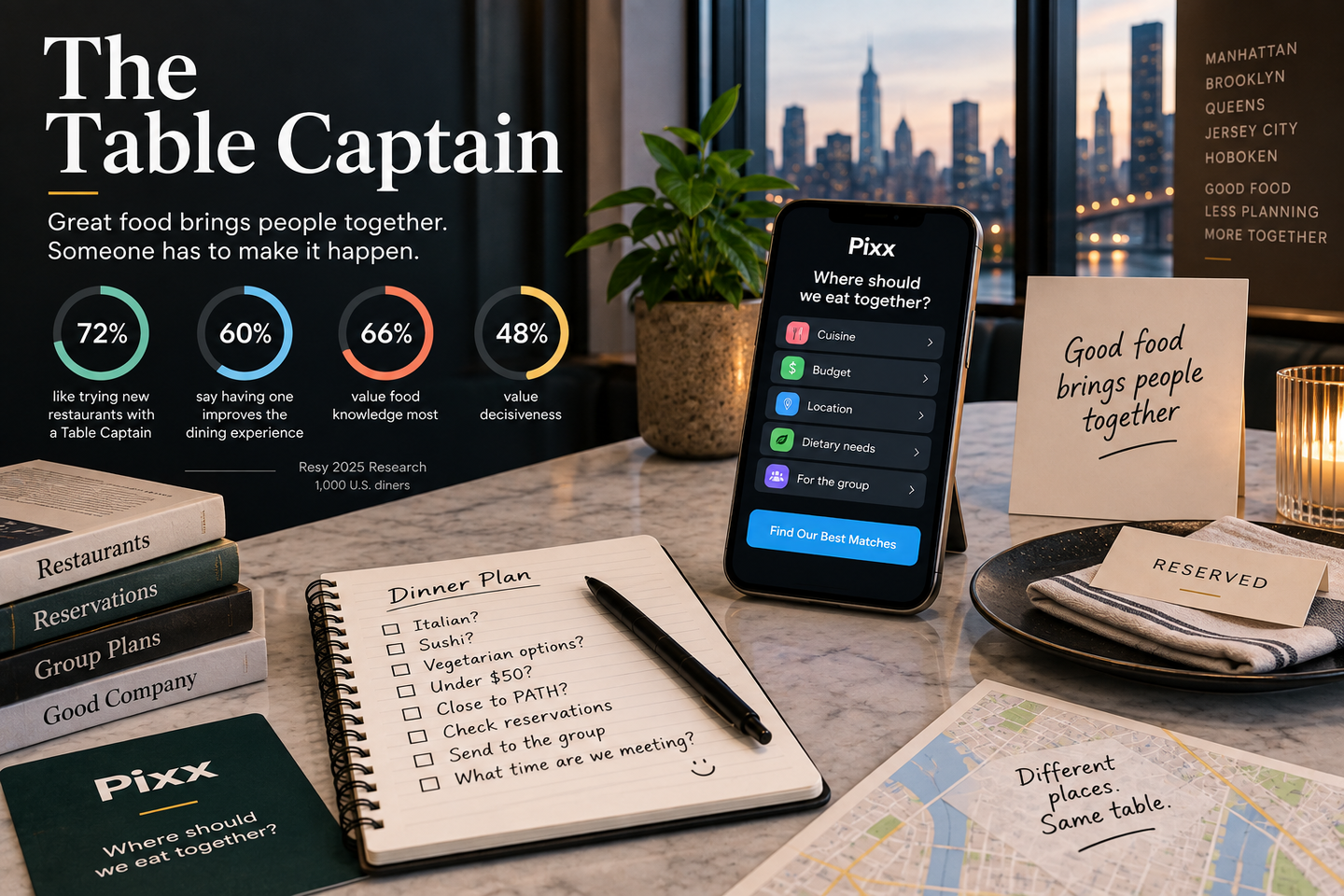
The question “Where should we eat?” sounds simple until four, six, or eight people need to agree. One person wants Italian. Someone wants sushi. Another person is vegetarian. One friend wants somewhere inexpensive. Someone lives in Hoboken, another lives in Brooklyn, and two people are coming from Manhattan. Someone sends three restaurant links into the group chat. Another sends a TikTok video. Someone says, “I’m good with anything,” and then rejects the first two suggestions. Twenty messages later, nobody has made a decision.
Eventually, the Table Captain steps in. That person researches restaurants, compares neighborhoods, checks menus, considers everyone’s preferences, looks at travel times, and pushes the group toward a final decision. Everyone else sees the restaurant that was selected. The organizer sees all the work that happened before the reservation.
Group dining creates a coordination problem because every additional person introduces another set of preferences. Cuisine, budget, location, dietary requirements, travel time, restaurant atmosphere, reservation availability, and even how adventurous people feel that evening all affect the decision. Someone eventually has to process these different needs and turn them into a restaurant choice.
Resy’s research helps explain why diners appreciate having a decisive organizer. Food knowledge helps the Table Captain identify restaurants worth considering. Decisiveness helps the group stop discussing options and actually make a plan. Both qualities matter because modern diners rarely suffer from a lack of restaurant information. Google, Yelp, Instagram, TikTok, Beli, Resy, OpenTable, food blogs, and creators provide endless restaurant ideas. The harder challenge is narrowing those possibilities down to one restaurant that works for everyone.
A highly rated restaurant does not automatically solve the problem. A great sushi restaurant is useless if half the group does not want sushi. A popular Brooklyn restaurant might create a difficult trip for friends coming from New Jersey. Another restaurant could sit in the perfect location but lack good vegetarian options. A different option might satisfy everyone but cost more than one person wants to spend. The Table Captain traditionally processes these variables manually.
That is why organizing dinner sometimes starts feeling like project management. The organizer asks whether anyone has food preferences. A few people answer. Someone suggests Italian. Another asks where. Someone requests somewhere close to the PATH. Another person wants downtown Manhattan. Someone else sends a restaurant in Williamsburg. Then a dietary restriction appears late in the conversation. Eventually, the organizer makes the call because somebody has to.
Technology should reduce that work rather than create another place to browse restaurants. Instead of expecting one person to collect six opinions through dozens of messages, a group dining service should gather those preferences directly and help identify the strongest overlap.
That is where Pixx fits. Pixx is built around one simple question: Where should we eat together? One person starts the dinner plan and sends a link to the group. Each person provides their own input instead of sending scattered preferences through a group chat. Cuisine, budget, dietary requirements, location, and other important considerations become part of the same decision. Pixx then helps the group narrow the restaurant choices based on what works collectively.
The Table Captain still plays an important role. Someone still initiates the dinner. Someone still gets the group moving. Pixx simply reduces the amount of information that one person has to keep in their head. Instead of replacing the organizer, Pixx supports the organizer.
This becomes especially useful in New York City and New Jersey, where geography adds another layer to group dining. Imagine friends traveling from Manhattan, Brooklyn, Queens, Jersey City, Hoboken, and Upper Manhattan. Finding good food is easy. Finding a restaurant that offers reasonable travel for everyone, fits the group’s budget, and works with different dietary needs becomes much harder.
Resy’s research suggests people still value having someone who takes initiative. The opportunity is not to eliminate the Table Captain. The opportunity is to make the job easier. The organizer should not need hundreds of restaurant choices. They need a small number of choices that fit the people who are actually coming.
Every friend group might still need someone to start the dinner plan. That person should not have to plan the entire dinner alone.