
Top Restaurant Apps for Groups with Dietary Restrictions
Top Restaurant Apps for Groups with Dietary Restrictions
· 5 min read
If you've ever tried to find a restaurant that works for a vegan, a celiac, someone with a tree nut allergy, and three people who "eat everything," you already know the problem. The group chat runs hot for 45 minutes. Suggestions keep coming. Nobody says yes. Everyone waits for someone else to pull the trigger. Meanwhile, dinner hour slips away.
Figuring out which restaurant app works best for large groups with dietary restrictions is harder than it sounds, because most restaurant apps were never built for groups in the first place. They hand you a filtered list for one person and disappear. Someone still has to open the app, run the search, cross-reference every restriction, convince the group, and hope they got it right. For parties with multiple dietary needs, that process breaks down almost every time.
This article evaluates the best restaurant apps for groups with dietary restrictions across three dimensions: how well they filter by diet and allergen, how much they actually support group coordination, and how reliably dietary information reaches the restaurant before your party walks in. One app, Pixx, approaches this problem differently from every other tool reviewed here, and that difference is worth understanding before you decide what to download.
What Actually Makes a Restaurant App Useful When Your Group Has Dietary Restrictions
Most people judge a restaurant app on two things: how many restaurants it lists and how clean the interface looks. For groups with dietary restrictions, neither of those is the right benchmark.
First is multi-restriction filtering: can the app stack vegan, gluten-free, and nut-free simultaneously and still return useful results? Single-filter apps are nearly useless for complex groups, even when the design is beautiful. Second is group coordination: can more than one person's restrictions be factored into the search, or does one person have to manually carry everyone's needs on their own device? Third is dietary data reliability: is the information in the app verified through contact with restaurant management, or is it crowd-sourced from user reviews with no audit trail?
When six people have six different restrictions, the single-user filtering model is structurally broken. The app sees one person's profile. It has no visibility into what the other five people need. That gap is where group dining falls apart, and it's the gap that most apps, even excellent ones, never close.
Data accuracy deserves its own moment here. For preference-based restrictions like vegetarianism, a user-generated database is usually fine. For anaphylactic nut allergies or celiac disease, data sourced directly from restaurant management is meaningfully different from a review someone left after a single visit. How an app sources its information is not a minor detail for serious diners with serious allergies.
Best Restaurant Apps for Large Groups with Dietary Restrictions, Filtering Tools
For individual restaurant discovery with special diets, a handful of apps genuinely stand out. Picknic leads on verified data in the U.S. market, covering 58,000-plus restaurant locations, including 60-plus national chains, across every major U.S. city. Its filtering covers gluten-free, peanut-free, tree nut-free, dairy-free, egg-free, soy-free, vegetarian, and vegan, all stackable in a single search. What separates Picknic from most dining apps for food allergies is its verification model: the team uses published restaurant materials and direct conversations with management, and each profile displays a last-updated date so you can judge how current the information is.
Where Filtering-Only Apps Hit Their Ceiling
One limitation is structural: Picknic is a personal discovery tool. Group coordination is not part of the product. If you're a solo diner or the one person doing research for the group, it's excellent. It does not solve the problem of collecting and synthesizing everyone's restrictions in real time.
GlutenGo explicitly supports dietary stacks, including celiac combined with nut-free and gluten-free combined with vegan. Foodini covers 150-plus diets and allergens with menu-level matching, useful for identifying specific dishes rather than just restaurants, based on the app's stated coverage. Both are strong tools for an individual or for the one designated person doing pre-dinner research.
That's also where their ceiling sits. Even the most capable vegan and gluten-free restaurant app in this category puts the filtering in one person's hands. That person makes assumptions, estimates restrictions they're not sure about, and sends a suggestion the group may or may not trust. It's a workaround, not a solution. For restaurant discovery that genuinely serves the whole group, you need something built differently.
Why Pixx Works Differently for Large Groups with Dietary Restrictions
Pixx is not a better version of the apps above. It's a different category entirely. Where every other app in this article starts with one person's search, Pixx starts with the group.
Here's how it works, according to Pixx: you create a meal event and send a single invite link to everyone in the group. Each person enters their own dietary restrictions and food preferences directly, no one guesses for anyone else. The AI then reads the full group's needs simultaneously and returns restaurant suggestions designed to work for everyone, with vegan, vegetarian, kosher, halal, gluten-free, and allergy accommodations factored in. The recommendation surfaces before anyone has had to argue, filter, or scroll. That's a meaningfully different experience from any app in this space built for individual use.
The no-account invite system deserves specific attention, because group coordination always breaks down at the participation step. If one person can't be bothered to download a new app, their restrictions get guessed or skipped entirely. Pixx says guests can RSVP, vote on options, and share their dietary needs through a link, no download required, no account creation, so everyone's information is in the system before the search even runs.
Smart location optimization runs alongside the dietary matching. Pixx is designed to surface restaurants that minimize total travel time for all group members, not just the person who sent the link. The result, in principle, is a restaurant that works for the group's dietary needs and their commutes. Pixx is available on iOS and Android, and it's one of the few group-dining apps built around this coordination problem from the ground up.
What Reservation Platforms Actually Give You for Dietary Needs
Once the group picks a restaurant, the question shifts to communication: how do you make sure the venue actually knows about the restrictions before your party walks in? This is where OpenTable, Resy, and Tock enter the picture, and where the gaps become significant.
OpenTable supports dietary restriction fields in its booking flow and lets diners direct-message restaurants to flag important needs. Restaurant staff can see guest notes, including dietary information, before the party arrives. That functionality is real and useful. The honest caveat is that the mechanism is largely free-text notes and direct messages, not a structured intake form that every staff member sees as a required pre-service step. For a large party where one person has a life-threatening allergy, a reservation note that may or may not get read before service is a real risk. Its value depends entirely on the restaurant's internal workflow.
For Resy, allergy and dietary tags can be attached to guest records and reservation notes, visible to restaurant staff through its management tools, though the practical value depends on how each venue configures its setup. The guidance for a group of eight or more is to include restrictions in the reservation notes explicitly, then follow up directly. For Tock, dietary details are typically collected during the booking flow itself, especially for prepaid or set-menu reservations where the restaurant needs to know requirements well before the event.
The bottom line for all three platforms: they handle the logistics of securing a table. They are not designed to verify that the restaurant can safely accommodate multiple specific restrictions for a large party. That verification requires a separate step that no reservation platform currently automates.
A Checklist for Safely Booking When Your Group Has Dietary Needs
Getting this right is a process, not a one-tap action. The steps below apply regardless of which apps you use.
Before you search: gather everyone's actual restrictions first. The most common mistake is opening an app before you know what you're working with. Use a group-first tool like Pixx, which collects everyone's preferences through an invite link before returning any suggestions, or at minimum send a direct message asking for specifics before you start browsing. The distinction between preferences ("I don't eat meat") and medical requirements (celiac disease, anaphylactic nut allergy) matters enormously for verification. They require different levels of confirmation from the restaurant, and treating them the same is how people end up in the emergency room.
Walk through it in this order when you book, don't rely on app notes alone for serious allergies:
- Enter the restriction in every available field: reservation notes, special requests, and direct message to the restaurant through the platform
- Call the restaurant directly after booking and confirm with a manager, not a host, asking specifically about shared fryers, cross-contamination protocols, and ingredient sourcing
- If anyone is celiac or anaphylactic, get a name and a written confirmation, not just a verbal "yes, we can do that"
On the day of the meal, the designated person in the group should mention the allergy again when the party is seated. Don't assume the reservation note was read, passed along, or communicated to the kitchen. A brief, clear reminder at the door isn't being difficult, it's closing the loop on a process that depends on human handoffs at every stage.
How to Pick Which Restaurant App Works Best for Large Groups with Dietary Restrictions
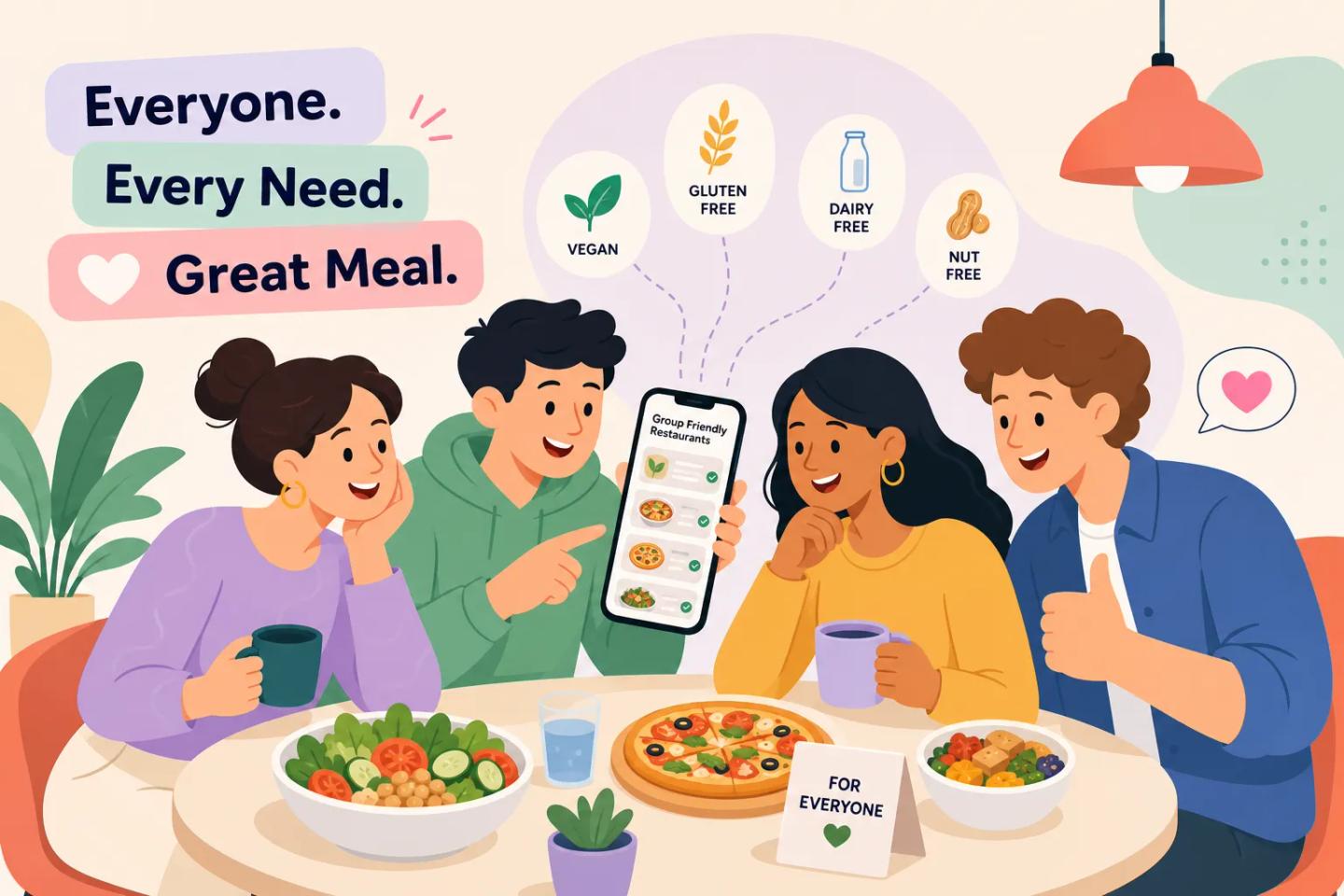
Most restaurant apps for dietary restrictions were built for individuals. They do a solid job of filtering restaurants for one person's needs, and apps like Picknic do that with genuinely verified data at real scale. But for groups with multiple restrictions, every individual-use app puts one person in charge of representing everyone's needs, and that's exactly where group dining decisions fall apart.
Pixx is designed to close that gap. It collects everyone's restrictions through a frictionless invite link, synthesizes the full group's needs simultaneously, and returns a recommendation before anyone has had to negotiate, second-guess, or scroll through a dead-end list. For groups with mixed dietary needs, that's not a nice-to-have feature, it's the entire difference between a decision and another 45-minute group chat.
The next time your group has a dinner to plan, start with a tool built to read the whole room. Pixx is available on iOS and Android, and your friends don't need to download anything to participate.