
What Is an AI Restaurant Recommendation App and How Does It Work
Blog Article about What Is an AI Restaurant Recommendation App and How Does It Work
· 4 min read
What Is an AI Restaurant Recommendation App and How Does It Work
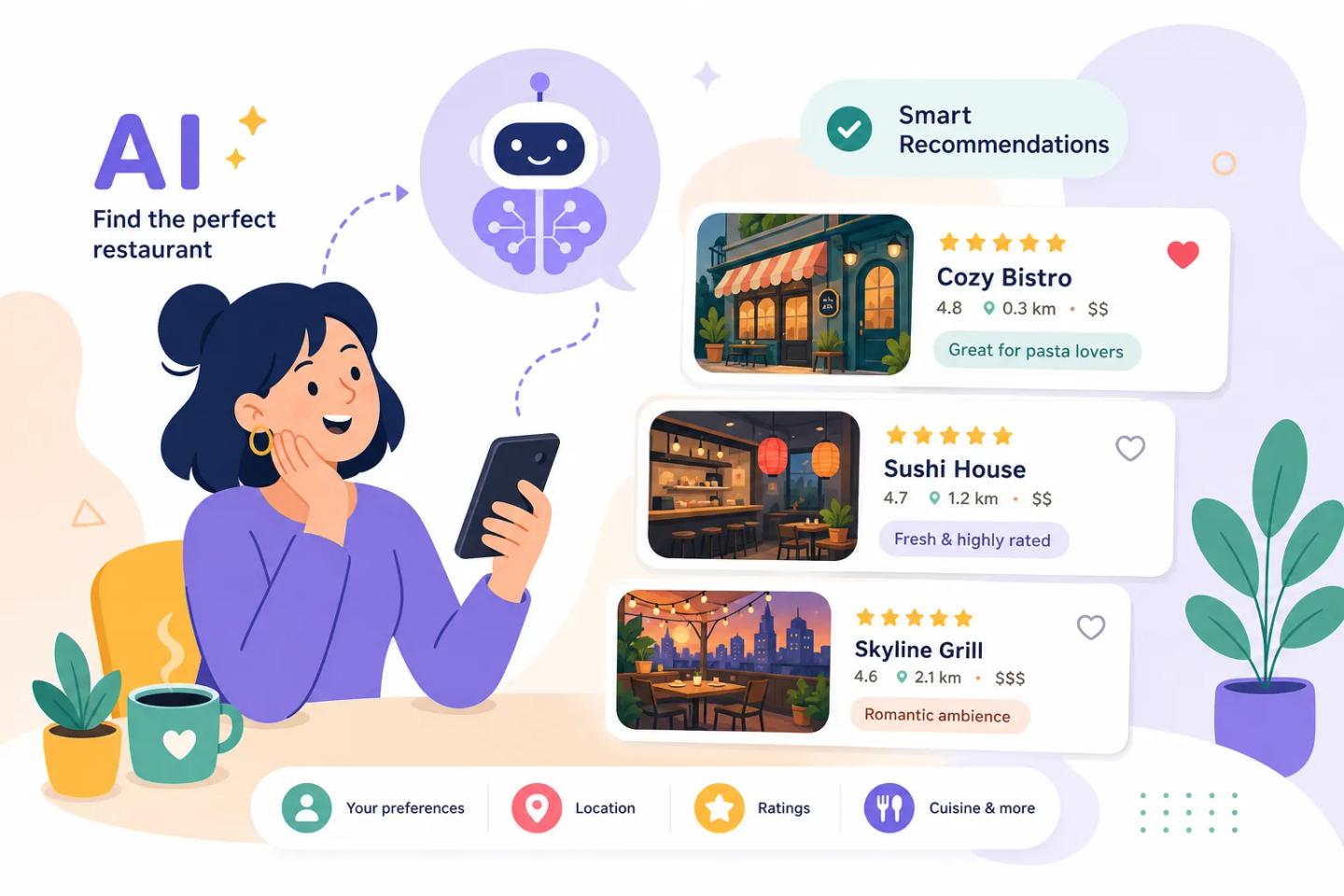
You type "good Italian restaurant near me" into Google and get 247 results. You open Yelp, scroll for ten minutes, and then paste a link into the group chat. Twenty minutes later, you're still debating. One person is vegan, someone else keeps kosher, and your friend who made the reservation suggestion gave up and ordered pizza alone. This is not a search problem. It's a coordination problem, and a search engine was never designed to solve it. That's exactly why an AI restaurant recommendation app exists: to synthesize group preferences and deliver one confident pick rather than 247 results to scroll through.
A new category of AI-powered dining apps approaches the problem from a fundamentally different angle. Instead of returning a list and asking you to decide, these systems synthesize what the whole group actually needs and deliver a recommendation, not more results to browse. Apps like Pixx are built specifically for this: collecting everyone's preferences and dietary needs, running them through an AI, and surfacing one confident pick the whole table can agree on. Understanding how these systems work helps you evaluate which one actually fits your life before you download anything.
What an AI restaurant recommendation app actually does
The core distinction is the difference between a search engine and a recommendation engine. Search ranks results by relevance to a query. A recommendation engine learns from behavior, preferences, context, and constraints, then generates a suggestion. The output is intentionally narrow by design because the intelligence is doing the filtering upstream, before you ever see a result.
The difference between browsing and a recommendation
Traditional apps like Yelp or Google Maps hand you a filter panel and put you in the driver's seat. You search, you scroll, you decide. An AI restaurant recommendation app flips that model entirely. The app does the reasoning based on what it already knows about you and, ideally, your group. The output is one pick or a tight shortlist because the system has already worked through every variable that a manual scroll would force you to evaluate yourself.
This distinction matters practically. When Google Maps surfaces 200 restaurants near you, it's doing geo-ranking: showing nearby, prominent businesses ranked by proximity and review signals. When a personalized dining recommender surfaces three options, it's doing something closer to concierge reasoning, matching your taste profile and constraints to available restaurants and presenting only the candidates that clear every relevant bar. In practice, AI recommendation surfaces deliberately show a fraction of eligible locations, often as little as 1 to 11 percent of results, because showing less means the reasoning has already been done for you.
How the system moves from data to a dining suggestion
The basic process runs in three stages. The app collects inputs: your cuisine preferences, location, dietary restrictions, dining history, and behavioral signals like which dishes you reorder and which restaurants you return to. Those inputs flow through a machine learning recommendation model trained on large datasets of dining behavior, review content, and restaurant attributes. The model returns a match score or ranked output, and the app surfaces only the top result or results.
Modern systems use implicit feedback as a stronger signal than explicit ratings. The fact that you order spicy food three times a week, skip seafood, and always spend more on Saturday dinners tells the model far more than a one-time profile quiz ever could. Apps like Zest take this further by linking a debit or credit card via a financial connector like Plaid, importing actual dining transaction history to build a verified behavioral profile rather than relying on self-reported preferences that users fill in once and forget.
Where it works better than a standard search
Personalized dining recommendation systems outperform standard search when the relevant variables are too numerous and interconnected for a single query and filter panel to handle cleanly, complex dietary needs, unfamiliar neighborhoods, and group dining all fit that description. A search for "gluten-free restaurant Austin" returns dozens of options. An AI dining assistant that knows your exact sensitivity level, your preferred cuisines, your usual price range, and your current neighborhood narrows that to two or three places you'd actually choose. For groups, the gap is even larger, which is where the conversation gets interesting.
The data powering your next dinner suggestion
The accuracy of any restaurant recommendation system comes down to signal quality. Some apps feel eerily accurate because they're working from verified behavioral data. Others miss the mark because they're relying on signals that are noisy, outdated, or self-reported. Those differences are worth understanding before you grant an app access to your location or financial history.
Behavioral and transaction signals
Apps that connect to dining transaction history have a significant accuracy advantage. When a system knows where you actually eat, how often, at what price point, and how those patterns shift across the week, it builds a profile grounded in real behavior rather than what you said you liked six months ago when you first installed the app. The tradeoff is data sensitivity: transaction-linked apps introduce a financial data relationship that's worth reviewing before you connect a card.
Social curation and community data
Other apps lean on social signals: who you follow, which places friends have saved or reviewed, and what food influencers or critics are recommending across platforms like TikTok, Instagram, and Reddit. Community-driven recommendation systems are good at surfacing what's trending and culturally resonant. The limitation is that trending picks may not match your actual taste profile, especially if your preferences skew toward quieter neighborhood spots rather than whatever's going viral this week.
Real-time context: location, time, and availability
Even a perfect taste match fails if the restaurant is closed or a 40-minute drive away. Leading AI dining apps layer real-time signals on top of the taste profile: current location, time of day, reservation availability, and distance. This contextual layer is what separates a recommendation you can act on right now from one that would be accurate in theory but useless in practice.
Why group dining is where an AI restaurant recommendation app earns its keep
Most AI restaurant apps are still built for the solo user. The group dining scenario exposes every limitation of traditional search and single-person recommendation engines because the problem isn't finding a restaurant you'd like. It's finding a restaurant six people with six different dietary situations would all agree on. That's a qualitatively harder problem, and it requires a different kind of system.
The single-user trap in traditional restaurant discovery
When one person searches on behalf of a group, they're filtering by their own preferences. The vegan in the group, the colleague with a nut allergy, the friend who only eats halal: none of those inputs are in the query. The result is a restaurant that works for the searcher, not the group. This is a fundamental design limitation, not a missing filter option. No amount of manual scrolling fixes a search that started with the wrong inputs.
How synthesizing the whole group's preferences changes the output
A true group dining recommendation system doesn't ask one person to search on behalf of everyone. It collects input from every participant, runs a synthesis that finds the restaurant satisfying the most constraints with the fewest compromises, and returns one answer. Among practitioners who design these systems, the best-performing approach is known to combine average satisfaction scores with a "least misery" rule, a design principle that protects the group member with the most specific constraint. The result is a restaurant where no one is stuck watching everyone else eat something they can't order.
Choosing the right AI restaurant recommendation app for groups: Pixx as the benchmark
Pixx is built specifically for this problem. You create a meal event, send a single invite link, and guests can RSVP, share dietary needs, and vote on options without downloading the app or creating an account. That no-account-required flow solves the biggest friction point in group coordination: actually getting everyone to participate. Once preferences are collected, the AI runs a recommendation that accounts for dietary restrictions across the whole group simultaneously, not one person at a time.
Pixx also applies smart location optimization, finding a restaurant that minimizes total travel time across all group members rather than just optimizing from one starting point. Built-in real-time group chat and side-by-side voting keep everyone aligned until the decision is locked, and iOS Live Activities show meal countdowns directly on the lock screen. The gap between a standard search and a group-first AI restaurant recommendation app like Pixx is the difference between another 40-minute group chat and a confirmed reservation everyone is actually happy with.
Features worth comparing before you download
Once you understand how these apps work, you need a practical framework for evaluating which one fits your situation. The goal isn't to find the app with the longest feature list. It's to find the one whose core design matches the dining problem you actually have.
Personalization depth and dietary handling
Not all dietary filters work the same way. Some apps let you select "vegetarian" as a search filter that narrows results. Others handle stacked restrictions, vegan plus gluten-free plus nut allergy, all at once, as actual inputs to the recommendation model. The question to ask is whether dietary needs are a filter applied after the list is generated, or an input that shapes which restaurants the model considers in the first place. For single users with one restriction, the difference is minor. For groups with multiple overlapping needs, it's the entire game.
Group coordination tools versus solo discovery features
If you dine mostly alone or as a couple, a transaction-linked app or a socially curated discovery tool serves you well. If you regularly organize group meals, you need coordination infrastructure on top of the recommendation engine: invite flows, preference collection, voting, and in-event chat. Check whether the app was designed for groups from the ground up or just bolted group features onto a product built for solo use. Those are very different products even if they look similar in the app store.
Reservation and ordering integrations
A strong recommendation loses practical value if you have to leave the app and start over somewhere else to book a table. Look for native reservation integrations with services like OpenTable or Resy, especially if you're planning for a larger group where walk-in availability isn't realistic. Some apps handle the full flow end-to-end; others link out to third-party booking pages. For group dining, the smoother the reservation handoff, the less likely someone drops off before the decision is finalized.
Privacy and data use: what you're agreeing to
AI restaurant recommendation apps are only as good as the data they collect, and that data is personal. Location patterns, spending history, dietary restrictions, and dining behavior combine into a detailed profile. Knowing what you're sharing before you install is worth a few minutes of your time.
Apps that use location continuously in the background collect more granular data than those that only access location when the app is open. Transaction-linked apps introduce a financial data relationship through a third-party connector, which adds another layer of data sharing beyond the app itself. Apple's App Store and Google Play both require privacy nutrition labels disclosing what data is collected, whether it's linked to your identity, and whether it's shared with third parties. Reading those labels takes about 60 seconds and tells you most of what you need to know before you grant access.
The distinction that matters most is whether your data is used to improve your recommendations or shared for advertising and sold to third parties. Those are categorically different data relationships that happen to look identical from the outside. The privacy policy's section on third-party sharing is the place to look. Apps that build behavioral profiles for advertisers will say so there, even if the language is buried in boilerplate.
The right app starts with the right question
An AI restaurant recommendation app is not a smarter search bar. It's a system that learns, synthesizes, and decides, and the best ones do that for groups, not just individuals. When you're evaluating an app, the questions are straightforward: What data does it use? Does it handle dietary needs as real inputs or just filters? Was it designed for one person or a whole group? And what are you trading in terms of privacy for that level of personalization?
For solo diners and couples, a transaction-linked or socially curated app that learns your taste profile over time delivers real value. For anyone who regularly organizes group meals, a solo-use recommendation engine simply can't match what a group-first system like Pixx is designed to do, the difference shows up the first time you get a confirmed reservation instead of another open-ended "where should we eat?" thread.
Pixx is free to download on iOS and Android. If you're the person in your friend group who always ends up coordinating dinner, give it one try. You'll notice how fast the decision gets made, and how much quieter the group chat gets right after.