
Yelp, Beli and Resy Help You Find Restaurants. Pixx Helps Your Group Agree.
Yelp helps you find restaurants, Beli shows where friends are eating, and Resy helps you book. Pixx focuses on a different question: Where should we eat as a group?
· 5 min read
Restaurant apps have become very good at answering individual dining questions. Yelp helps answer, “Where should I eat?” Beli largely helps answer, “Where are my friends eating?” Resy helps answer, “Where should I book?” Each service handles a useful part of the dining experience, but eating with a group creates a different problem. The question becomes, “Where should WE eat?” That one word changes the entire decision.
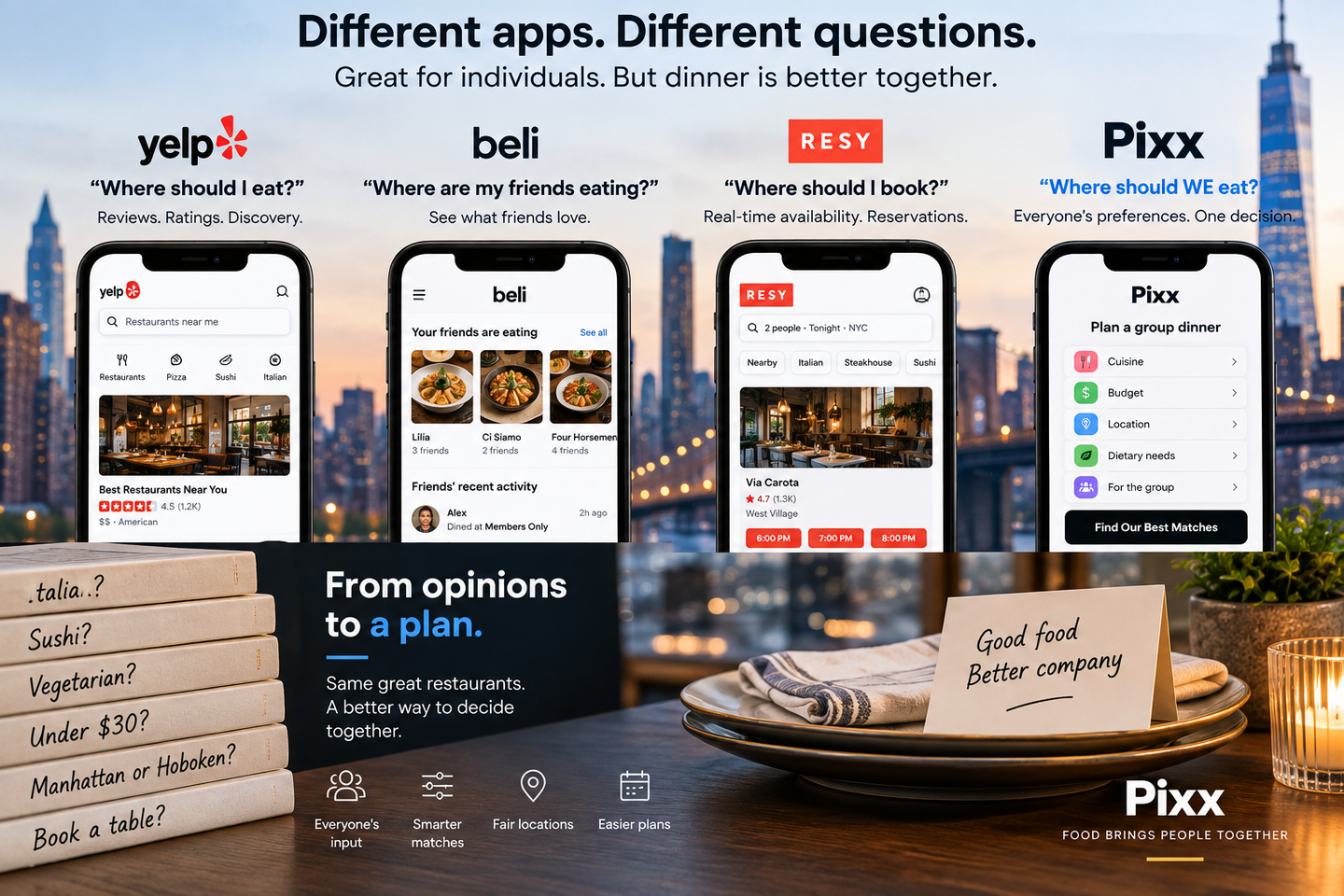
Finding restaurants is no longer difficult. Open Google Maps, search Yelp, scroll through TikTok or Instagram, check Beli, or browse Resy, and within minutes you have dozens of restaurants to consider. The difficulty begins when everyone in the group has their own opinion. One friend wants sushi. Another wants Italian. Someone is vegetarian. One person wants to spend $30. Another wants a more upscale restaurant. Two people live in Manhattan, someone is coming from Brooklyn, and another person is traveling from Hoboken. At that point the group no longer needs more restaurant discovery. The group needs agreement.
Yelp works well for restaurant discovery because people search based on cuisine, location, price, ratings, reviews, and other criteria. That experience makes sense when one person controls the decision. You search, compare options, and choose. Group dining introduces more complexity because one person’s ideal restaurant might be a poor option for someone else. A highly rated sushi restaurant does not help when several people do not want sushi. A popular restaurant in Brooklyn becomes less attractive when part of the group is traveling from New Jersey. The issue is no longer whether a restaurant is good. The issue is whether the restaurant works for everyone attending.
Beli brings a social layer to restaurant discovery. Instead of relying entirely on anonymous reviews, users see restaurants their friends have visited, liked, or ranked. That helps answer the question, “Where are my friends eating?” Social recommendations have value because people often trust friends who share similar tastes. Yet knowing that several friends loved a restaurant does not automatically mean that restaurant works for tonight’s dinner. The price could be too high for one person, the location could be inconvenient, the menu might not fit a dietary requirement, or the cuisine might not appeal to everyone in the group.
Resy solves another important part of dining. Once the group knows where it wants to go, someone needs to find a table. Reservation availability, time, party size, and restaurant demand all matter. Resy therefore helps answer, “Where should I book?” But a reservation platform usually becomes most useful after the group has narrowed the choices. The agreement problem happens earlier.
Pixx approaches restaurant planning from the group’s perspective. Instead of starting with one person searching for a restaurant, Pixx starts by gathering what everyone needs. One person starts a dinner plan, friends join, and each participant shares preferences. Cuisine, budget, dietary requirements, location, travel considerations, and other factors become part of the same decision. The goal is not to produce another long restaurant list. The goal is to narrow the choices to restaurants that make sense for the group.
The word “we” creates the complexity. One person might only need to think about what food they want, how much they want to spend, and how far they want to travel. Add five friends and suddenly six sets of preferences influence the choice. One person wants Italian, another prefers Asian food, someone is gluten-free, another wants easy train access, another wants to stay under $40, and someone else claims to be fine with anything before rejecting half the suggestions. Traditional restaurant search handles individual intent very well. Combining six different sets of intent creates a different problem.
Most groups currently try to solve that problem in iMessage, WhatsApp, Instagram DMs, Messenger, or another group chat. Someone asks whether everyone wants dinner Friday. People agree. Then someone asks where. One person sends a Google Maps link. Another sends an Instagram Reel. Someone sends a Yelp page. Another person suggests a neighborhood instead of a restaurant. Two people do not respond. Later someone mentions a dietary restriction that nobody considered. Restaurant options increase while clarity decreases.
The group does not suffer from a lack of information. The group lacks a structured way to reach consensus. Pixx is designed to add that structure.
Pixx does not need to replace Yelp, Beli, Resy, Google, TikTok, or Instagram. Those platforms already perform useful roles. People might discover a restaurant through TikTok, Instagram, Yelp, Beli, Google, or a friend. They might use Pixx to determine whether that restaurant, or another option, works for the whole group. Once everyone agrees, they might use Resy, OpenTable, or another reservation service to secure the table.
The services therefore answer different questions. Yelp asks, “Where should I eat?” Beli largely asks, “Where are my friends eating?” Resy asks, “Where should I book?” Pixx focuses on, “Where should WE eat?”
The distinction becomes especially clear in New York City and New Jersey. Imagine six friends living in Hoboken, Jersey City, Brooklyn, Queens, Midtown, and the Upper West Side. Everyone has access to thousands of restaurants. Restaurant availability is not the core issue. The challenge is finding somewhere that feels reasonable for everyone. One person should not travel more than an hour while everyone else travels 15 minutes. A restaurant might have the perfect menu but the wrong location. Another might have a convenient location but exceed the group’s budget. Another might fit the budget but fail to accommodate someone’s dietary needs.
Group restaurant planning therefore requires a different type of recommendation. The useful question is not simply, “Is this a good restaurant?” The useful question is, “Is this a good restaurant for this specific group?”
Consumers already have endless restaurant lists. They have lists of the best Italian restaurants, best date-night restaurants, best restaurants in Manhattan, best restaurants under $50, best new restaurants, and best places near major landmarks. More restaurant lists do not solve disagreement between friends.
Groups need fewer choices that better reflect the people who are actually going to dinner. That gives Pixx a clear role between restaurant discovery and restaurant booking. Someone says, “We should get dinner.” Pixx helps the group reach, “Great, see everyone there.”
When one person asks, “Where should I eat?” many services already provide useful answers. When several people ask, “Where should we eat?” that is the problem Pixx is built to solve.